Monday, June 07, 2010

barcelona day two

No alarm clock this morning. Yeehaw.

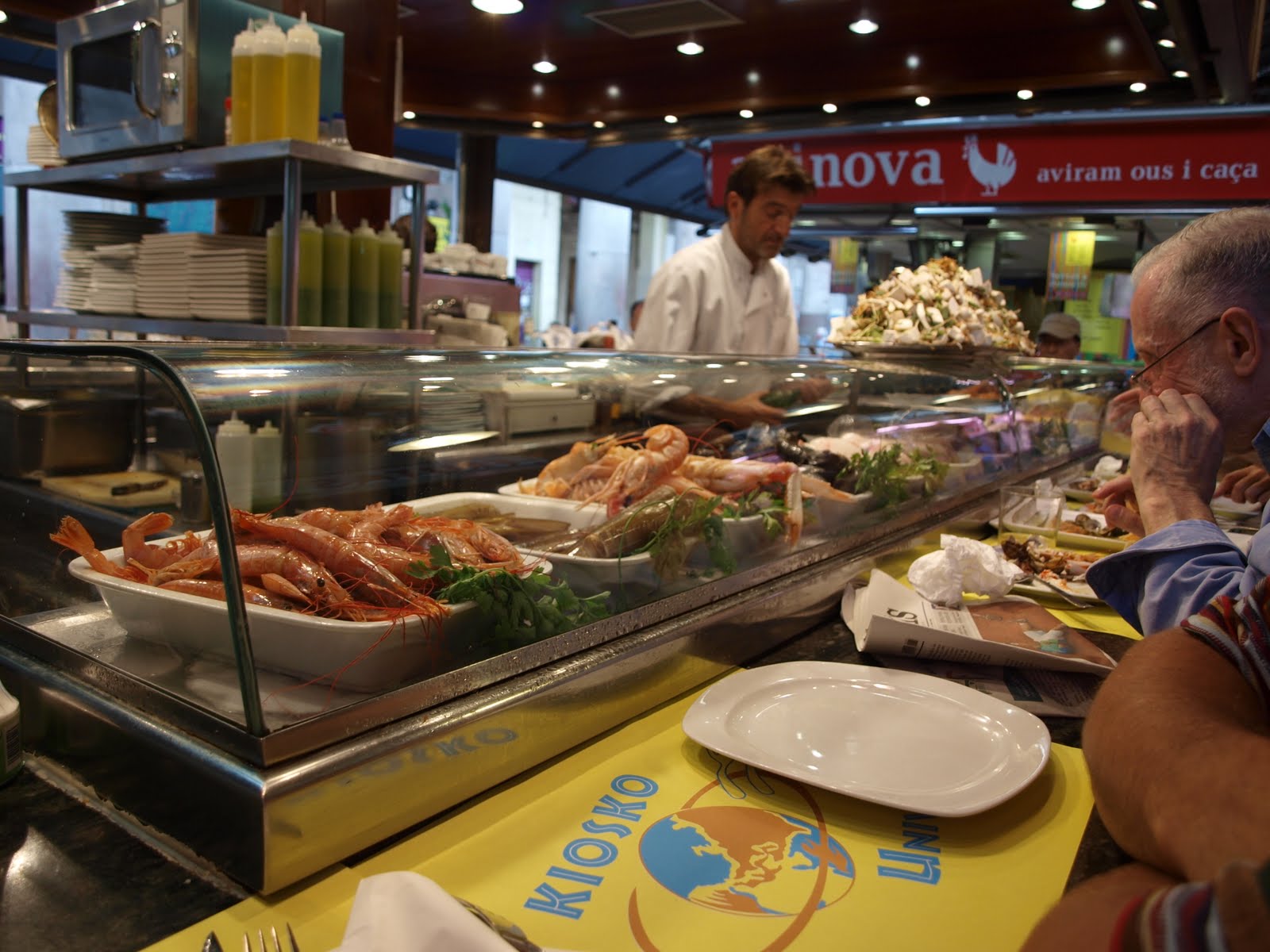
We strolled down the ramblas to cafe zurich for a quick coffee then on to the Boqueria market for a look around. The presentation at every single stand was astounding. Each stall a rainbow of colours, seafoods, blackened legs of ham, chocolates, nuts, sweets, veg. We started with a little paper cone full of croquettas of salt cod. In the end, Kiosko Universal got our vote for lunch. We shuffled a stool or two to make room for ourselves (occasionally having to get up to let the next shift in under the counter). The stand was an island, three men hustling inside a bar lined with glass shelves and white platters of fresh seafood; on the outside of the glass, a U of happy people perched on stools, oily fingers clasping glasses of beer or wine. We ordered a couple of glasses of Cava, a bubbly white wine perfect for daytime, some tiny little clams, razor clams, all fresh from the sea thrown on the griddle with a splash of oil and some crystal salt. Then some calmar on a bed of fresh fries. As soon as any of it came off the griddle, our man behind the bar squeezed an oil & garlic & parsley emulsion over the whole thing. OH MY GOD! On the top of the bar was a huge rectangular plate of mixed mushrooms which we couldn't resist. Again, fried in oil and perfect and delicious. A few chunks of hearty bread to soak up the last drops.

We wandered back to the bicycle rental place where the new attendant, upon hearing that we were from Quebec, hit us with a very interesting (post-cava) but long-winded talk about separation and the oppression of the catalan people by the centralist spanish government. We rode through the Barri Gotico, a maze of narrow alleys with foot-deep wrought-iron balconies lined with flowerpots and washing hanging overhead. Every alley hits you with a new view of the city, impossible-to-resist hidden corners, glimpses of spires, stone arches. A little shopping at Camper (can you come to Spain and NOT go to Camper?). Sandals for me. Metrosexual running shoes for my hot husband. Past the statue of Cristofol Colom pointing toward the new world and down to the sea. Then along the beach crowded with topless and occasionally naked spaniards, wandering masseuses, and very pink and very drunk brits. Bike paths abound, we rode on through La Ciutadella park and back up to the hotel for a snooze. Siestas are so civilized.

Awoke to the lovely sounds of an accordeon playing in the street.

Off to Cal Pep, our first choice for dinner, where we decided that having people standing in line behind you while trying to enjoy dinner wasn't what we were looking for. The long walk in the new shoes back across town into Parallelo to find Quimet y Quimet, a tapas bar that has been handed down from Quimet to Quimet since 1914. Brother and sister man the place. An eight-foot long bar, a pair of square-foot round tables in the middle of the floor. No seating. The fifteen foot high walls lined with floor to ceiling bottles and their posted price by the glass. We nudged our way into a spot at the bar and watched Sr Quimet concocting tapes. Little rounds of bread topped with sour cream, salmon, tapenade and a generous drizzle of honey. "Any advice for us?" I asked a Spanish trio on our right. Take whatever he tells you to take" was the answer. "He makes the best tapas in Barcelona!" Wil ordered a couple of glasses of cava and pointed to something on the bar, a practically liquid round of sheep's milk cheese. Sr. Quimet spooned a heap onto a round of bread and topped it with a few sweet, pickled chestnuts. Then a mixed platter of fish and one of seafood. Slices of salmon, sardines, bacalao, hot-smoked slices of tuna, smoked oysters with little piles of tomato salsa & tapenade, the other plate razor clams, calmar, and tiny little clams. We chatted with our neighbours, Teresa, her brother and her husband, who was a gypsy. She was born in Valencia but her parents moved to Barcelona when she was six months old. She and her family obviously did not share the bike rental guy's feelings about Catalunya and its need for independence. "We refuse to speak Catalan" they said. Teaching only Catalan in school makes us backward and keeps us from moving forward. When I asked her questions about what was on her plate, she handed me little slices of things, a thin slice of bright orange cheese, a chunk of blue, a little cube of manchego. We bought them a round of beers, they countered with a round of cava.

She tut-tutted Wil when he put down a tip on the bar. One euro is more than enough, she said. Four is criminal! We walked back, sandals in hand with my new-shoe-blistered feet, through a neighbourhood completely different from the other side of the Ramblas. Clusters of muslim women with strollers chatting while their older children pushed scooters in the deserted streets. Halal and shawarma shops testament to the big north african population. Past black-as-night African vendors with their Dolce & Gabbana handbags or sunglasses laid out on square sheets with ropes tied to the four corners, one hand ready on the rope to pull the whole into a tidy bundle for a quick getaway? Sunburnt brits in white tube tops and floral flipflops.

Barcelona is fantastic.

Sunday, June 06, 2010

barcelona


Our tearful departure from Abercorn wasn't nearly as difficult as I expected (except for me!). The kids, now with Mia & Kai, waved us off as I snivelled and bawled in the car. The flights were seamless, except for one AC employee telling us that checking our bags in would not hamper our attempt to get on an earlier flight, only to find out five minutes later that we couldn't possibly get on an earlier flight if our bags were already checked. Thankfully, it was the only hiccup.

Despite all my best efforts to sleep on the flight — coughing up for the stupid, fleece-covered donut pillow, the black satin eye mask, the 50 decibel earplugs, not to mention draining my parents' pharma shelf of some major tranquilizers — I still only managed to get in an hour or two. I ended up curled up on the floor (which elicited a "well... aren't you flexible!" from the stewardess as we deplaned.)

The trip into Barcelona was fun — figuring out the quickest and cheapest way in on the train. We wandered up the Rambla de la Catalunya and found our little hotel (Praktik Rambla) tucked into a non-descript facade. The young receptionist was lovely but our room wouldn't be ready until at least noon and it was only 9. Aargh. She handed us a free umbrella for the spitting sky, we left her with our bags and headed out. We stopped in to a little bar/resto next door and pulled up a couple of stools. Delicious, creamy cafe con leche with a yummy little crunchy sandwich — a lot like a ciabatta with slices of serrano ham and cheese. We strolled down the tourist-choked Rambla, a gorgeous, wide pedestrian avenue lined with vendors — of postcards and souvenirs and songbirds — that leads all the way to the beach.

We were impressed with the strings of Bicing bikes (like bixies in Montreal) strewn all across town but were disappointed to find that they weren't available to tourists. We opted instead for a pair of black witch-in-the-wizard-of-oz bikes. We hopped on and headed over up to Sagrada Familia, Gaudi's freakish cathedral. We didn't brave the interior, the line-ups were just too long. Sundays in Barcelona are quiet. No traffic to speak of. A perfect introduction to pedalling around the town.

We made a quick stop at the place next door for a beer and a taste of one of their yummy tapes. A piece of bread covered with a mahi-mahi mousse, topped with aa fresh anchovy and a little pickled pepper and a yummy platter of mixed olives. mmmmm. Quick, oh-so-delicious nap at the hotel. The room is lovely, a strange combo of classic and modern, fifteen-foot high ceiling with elaborate plasterwork, painted in black and white stripes with the addition of an ultra-modern bathroom housed in a mirrored box in the corner of the room. Every inch of floor covered in beautiful tilework that changes from room to hall. Our little balcony overlooks the Rambla. Feeling seriously lucky. After our snooze, we climbed the hill on our bikes (puff, puff) to Parc Güell, the crazy multi-level park with a killer view of the sea designed by Gaudi and where he spent his final years. After the climb up to the park, we cruised back down through the lovely labyrinth that is Barcelona.

Later on to Taller de Tapas for a bottle of rosé, a plate of octopus and potato in olive oil and paprika, buñuelos, little deep-fried croquettas of salt cod (I couldn't help thinking of us crowding around Ana Maria's frying pan on those lucky days on Wilson avenue) and last, but definitely not least, a plate of a variety of fresh mushrooms fried in olive oil and caramelized garlic with parsley. Spectacular food. We returned the bikes, bought a brick of Torró d'Alacant - almonds, honey, sugar and egg whites, my new favourite sweet thing and then home for a little R&R and then off to supper at 10!

We searched high and low for a place we'd read about but we couldn't find it. Instead, we settled into a couple of chairs on the sidewalk outside a cute little family place on a corner. With nary a tourist in sight, which is no easy feat in Barcelona. A bottle of cava open on many tables. We had fresh grilled sardines (which are in no way related to the goopy, oily mess that comes out of the can), a fish soup (which couldn't have been more different from the Mexican version) a thickish, tomatoey soup with chunks of white fish and rice. A little green salad, lettuce, tomatoes and onions with a bottle of oil and a bottle of vinegar brought to the table. And slices of chewy baguette. All rounded off by a bottle of chilly cava.

Friday, March 05, 2010

the usa

The drive to the border was totally depressing. The mountains that leant interest to the landscape pulled away from the road and all we were left with was the flat scrub wasteland that is the north of Coahuila. The frontera has a flavour all its own. It just feels like outlaw country. We drove through a half dozen tiny towns on the way, rusted out vintage pickups bumping around dusty, wind-swept streets. No matter how small the pueblo, each had its own zocalo and gazebo. We stopped in Allende, 45 k south of the border to hand in our visas and give back the car import hologram which has been on the windshield since we crossed over. Watching the lady unceremoniously scrape it off felt like a slap in the face. I'm feeling ridiculously sentimental about the bits of colourful shreds she left. The name of the border town, Piedras Negras (Black Rocks) made sense as we drove past the massive cloud surrounding the Coahuila coal-burning power plant. We stopped for a quick lunch. Henri said afterward that he couldn't believe that he wasted his last meal in Mexico on a burger.

As usual, we were nervous about the crossing, being at the mercy of some yahoo with a gun. We waited and waited, inching our way forward in a sea of pickups with US plates. Of course they wanted to search the car. The US border guards could learn a lot from the Mexican military who never seem to forget that it is your car they are rifling through. They knocked every little corner of the van looking for hidden compartments, the dog hopped in and sniffed around. The guard was alarmed that we had hidden away a ziploc of money and photocopies of our documents under the dash. We explained that it was our safety net in case our wallets were robbed on the road. The look of disgust and disbelief on his face said it all. Forgive us officer, we were trying to pull the wool over your eyes. We were desperate to smuggle these photocopies of our passports and $120 dollars into the country and you caught us, you clever clever man. Aargh! Where do they find these people?

Crossing into Vermont from Abercorn is always a bit of a jolt to the system. It always surprises me how people living in a town just eight kilometres from my house can be so different. Crossing from Mexico into the US is a shock of another order. I acknowledge that Texas border country is not the best the US has on offer but it was a demoralizing contrast just the same. Gone are the little taco shacks and tiendas, women dressed like well... women, music and colour and life, replaced by mobile homes and towering billboards and a lot of large people in leisure suits behind the wheels of their large cars.

Texas is a giant, as endless as Ontario on a cross-country road trip. Through San Antonio and Houston on the 10. The billboards say it all. Gambling, god and insurance. In that order. We pulled out the beds at 8, made it over the Louisiana border by 11, pulled into a rest area and slept 'til 6:30. We need to get off the interstate if we're going to survive this leg of the trip without going into a major funk.

The late night driving gave me some quiet time to think, about our family and our trip and Mexico. It'll be interesting to see what the fallout of our road trip is on the kids and their life outside of home. I know they'll be fine but I'm not sure I'm going to be able to let them get on the bus on Monday. As for Mexico, I worry. Being America's neighbour, with its culture of immediate gratification (enjoy now, pay later) cannot be good for a country where so very many people are so very poor. They get the same message from the media as we do but they don't have the means. Can that kind of dissatisfaction breed anything but frustration and anger? I could be wrong but the dated appeal of the Catholic church seems to be slipping, creating a void that seems to be filling with more hardcore varieties of religion, with seventh-day adventists, jehovah's witnesses and baptists building followings all over the country. On the health front... yikes. #1 in childhood obesity is not a ranking Mexico can be proud of. Stores are full of crap, cheap sweets and sodas. Every village, no matter how small, has a tienda with a fridge bursting with ice-cold Coca-Cola.

We woke up and blasted through Louisiana and into Mississippi, looking to pick up the Natchez Trace Parkway right over the border. We stopped for groceries on the way in Vidalia. I had a surreal moment in the grocery store watching an exchange between a bag boy and a customer in the aisle. The customer, a very large young black woman with white and pink bangs, a leopard-skin top two sizes too small and spike hells chased a bag boy down the aisle. The scrawny fellow, a flap of greasy hair hanging over his eyes, buck teeth, hoodie under his white apron, was pinned against the cereal boxes. She pulled something out of her massive handbag and peppered him with questions in a very aggressive tone. Their heavy accents fell so squarely into the stereotype of a Southern drawl, I was completely transfixed. I knew I was staring and yet I couldn't pull my eyes away. I may have spent the last two months in Mexico but this, I thought, THIS is foreign.

The Natchez Trace Parkway, a road commemorating the path native Americans used to travel from north to south was a delight, despite the seriously crappy weather. Gone were the strip malls, the eighteen wheelers, the giant billboards. Instead the little two-lane road wound in and out and up and down through majestic hardwood and pines for over 400 miles. The art deco bridges were things of beauty. The grassy banks, full of flocks of wild turkey and chubby little robins, rolled away from the road. It was easy to imagine travelling the trace in more civilized times, on horseback, by carriage, even on foot. Not the quickest way, I'm sure, but a more pleasant way of getting through Mississippi would be hard to find. A welcome antidote for all the venom we were feeling about America.

Our thought was to go from the Natchez (which ends near Nashville) to the Blue Ridge Parkway (which begins outside Knoxville) and then find someplace to camp but the weather was not cooperating. The van was objecting more and more to being started. We chased down some glow plugs in Knoxville, but didn't have the tools we needed to change more than two of them. The Comfort Suites have become our home away from home. After a discussion over dinner we decided that, rather than drawing out the driving time, we'll put in a marathon day of driving and then spend a couple of nights in the Big Apple, putting us a day away from home for friday.

The van started this morning but when we stopped for gas a brand new problem arose. The death rattle of the clutch in low gears has got my poor husband pulling his hair out. The worrying hours he has expended on this vehicle need to end soon. We may just have to skip NYC and stay on the road until we get home. We've been driving for six hours now, with another six to go. We'll make the call when we further north.

The interstate is awful, bad drivers with bad manners, the worst of the country on display from the road, drivers using their vehicles to witness their faith. "Jesus Christ is Lord, not a swear word"; the clever "Where you go in the hereafter depends on where you go after here"; and my personal favourite, "When God is for us, who can be against us?" The answer to that last one may lie in the endless stream of pale brown tanks and jeeps mounted on transport trucks going past us on the road south.

Wil made the call that he thought the van could make it home. We got on the New Jersey Turnpike and headed toward our hotel in lovely North Bergen, across the river from midtown Manhattan, the thinking being that avoiding driving into Manhattan would put us in a good position to get back on the interstate without getting stuck in traffic. The one thing we weren't sure the car could handle was a lot of clutch, in low gears, in traffic, on bridges, or in tunnels. As we approached North Bergen, in the dark after eleven hours straight of driving, we made our final, tense approach. The kids were fed up. Wil and I were exhausted and already worried but when the Pulaski Skyway turned out to be a bridge and when the clutch started slipping moments before getting on, major panic set in. Wil had been shifting without the clutch most of the way from Knoxville which worked well on the way up. Slowing down was not so fun. Every time we came to a stop we feared it would be for the last time.

Rather than hang around and worry, we took a little mini bus into the city. $2.50 for a fifteen minute ride to Port Authority at 42nd & 8th. We wowed the kids with Times Square and walked down to the Empire State Building. The security guards were mostly petite black women in doorman-style red suits, all under five foot, faces half-concealed by the broad brim of their hats. We asked one of them "Should we pay the extra to go up to the 102nd floor?" (what was originally designed to be the waiting room for dirigibles). "It's a little room", she said. We waited for the rest of the answer but it never came. "I'm not gonna tell you what you to do." Alright then. The security was a surprise, though it probably shouldn't have been. Full-on airport style, belts off, the works. The maze of velvet cords made us realize how lucky we were to avoid the crush of people that must come through here during the day. Then up the two elevators to the observatory and the view. The wind swirled around us, the lights sparkled up and down Manhattan, the sheer drop off the side of the building and the teeny little cars below amazed the kids. A heavy snowstorm blew past us but not a drop of snow made it down to the street below. Island as super radiator. The languages we heard on the elevator made it feel like the United Nations, a welcome change from the homogeneity of the South. We searched high and low for a place to eat dinner in midtown. We looked and looked. As we walked crosstown, a middle-aged man who walked just ahead kept looking over his shoulder at us. I thought Henri's leaps over the garbage bags on the sidewalk were stressing him out but it turns out he wanted to make sure we knew where we were going. O miracle of miracles, a New Yorker in New York, in a ratty overcoat, collar askew, 30-year-old briefcase under one arm. "We're actually looking for a diner." "Kosher? Do you need kosher?" "Um, no... We heard about the 2nd avenue diner." "It's alright but for a corned beef, for a corned beef they charge $12.50!" He told us about a couple of other places. "This is my neighbourhood", he told us. As we thanked him and walked past he turned in toward his front door, a swanky highrise on fifth avenue.
We found our dinner and then walked back to Port Authority and North Bergen.

We headed back into the city in the morning after finding Juan, North Bergen's diesel guy and having him reassure us that if we topped up the oil every hour we could make it home. The kids really wanted to see the Statue of Liberty. Wil and I were dreading more lineups but we figured this might just be the one and only time. We wandered around downtown for a while, poking around some lovely bookshops and trying to find Phil & Sarah at Canada. Then to Chinatown for an early lunch. The first restaurant was being visited by the health inspectors so they redirected us to a place on the corner. Vegetables never tasted so good.

We went down to Battery Park hoping that the view from shore would satisfy the kids. Sadly, it didn't. We bought our tickets and went through the security rigamarole again to board Lady Liberty. It was windy and cold. Homeland security had obviously had a hand in reworking the piped-in recording about the history of the statue post 911. It was all a bit much.

Another subway uptown, a look around snowy Central Park, the requisite (always disappointing?) pretzel, a wander down regal Fifth Avenue to wonder at the wealth, then back downtown along Broadway, Canal and up into Little Italy for dinner. The maitre d's stood outside pitching us on their too-long menu, the New York version of the Mexican stall ladies, promising free desserts for the kids. We picked a quiet little place with no salesman and chose well. Dinner was delicious. The kids asked me how to say thank you in Italian. I told them gracias might be more appropriate for everyone but our waiter. Our bus boy was obviously thrilled to hear the kids speak Spanish. He asked where they learned it and we told him about our trip. "What part of Mexico did you see?" "All parts." "I am from San Luis Potosi," he said (one of the few big towns we'd really wanted to see that didn't fit into the itinerary). I so wanted (and I think he so wanted us) to be able to say Yes, we were there and it's beautiful. In New York for seven years, alone, no family in the U.S, never been able to get back but planning a visit for next year. "My mother really misses me." I wanted to give him a hug. We talked about the different family values in North America and how hard it must be for a Mexican to be without family for so long. When the other bus boys heard us speaking Spanish, they hovered around the table wanting to talk about their hometown. So many young people working like dogs in the big city, supporting their families at home, lonely and so far from home.

We hit the sack early, hoping to be on the road by six, to avoid the stop-start of rush hour in the Big Apple. The drive was tense, listening intently to the engine as the clutch struggled to do its job, dreading the uphill, hailing the down. Strangely enough the snow in New York State thinned out as we got further and further north. We hadn't seen the sun since we crossed into Texas but it started to shine in the Adirondacks. Threads of Canada geese draped across the sky. If that isn't a signal that it's a good time to head north I don't know what is. Those robins we saw in Mississippi will be here soon. The kids are bickering in the back, talking excitedly about the things they are looking forward to seeing. We're all anxious to get home.

Home sniff home. Home safe.

Monday, March 01, 2010

Cuatro Ciénegas

We finally got where we were headed, Cuatro Ciénegas, the town that marks the beginning of the National Park. The sides of the roads were alive with mounds of hairy cactus fingers, the limp kind you find on sale in pathetic little green pots at the supermarket. The land between the mountains couldn't have been flatter, plains of pale, tall grass rippling in the wind. We made it into the park, the first signpost indicating a white track leading off into nowhere, the second was the visitor's centre. We went in and asked about Becerra, the place we were hoping to camp. It's closed. It's closed?! Is there another place we can camp? Rio Mezquites, the track you just passed, but I'm not sure if it's open. If the gate is locked you need to go back to the town to find Don Arredondo to ask permission. The kids were dying to get out of the car. It was four and we'd been driving since nine. We pulled off onto the track, veering left and right to avoid the massive ruts. The open ground was entirely white. Suddenly the plaster factory we'd seen off the main road made sense. Through one unlocked gate. A little further along another gate, this one closed and beside it a pickup parked in the shade of a palapa. I jumped out with Felix and started the pitch. Can we camp? He pointed into the distance (you can see a long way in the desert), back at the town, that white building, you can camp THERE. But....we've come from so far and we're going back to Canada on Sunday. Please, please. We don't need water or showers or toilets. He was considering it. For a special price? The gears started whirring. He called over his employee to discuss. They talked it over for a few minutes and then proposed a price. Sold. He handed over a key to the gate in case we needed to get out in case of emergency, pointed down the left hand track and said that Juan would be back in the morning to collect the key. Yeehaw!

All we could see from the track were very basic palapas and these strange white conical shapes in the distance. We had no idea where we were going. The road snaked through the grass, past some of the structures and then into an open area surrounded by palapas. We pulled in to have a look. Beside every palapa was a little opening in the grass with a tiny set of wooden steps that led down into the rio, a shallow, crystal clear river of palest green and blue, the banks tall gold grass. The Rio Mezquites is a desert river, not the kind I've ever seen before, that emerges from the ground and then disappears, only to reemerge a few hundred feet away. The bottom of the river is firm, with bulbous white rock formations, tiny minnows flicking around the shore, bigger fish slinking around the rocks. The grass is so tall and the land is so flat that you'd never know the river was there unless you fell into it or clambered up one of the mountains and saw the sun reflected in its surface.

We drove to the end of the track, parked the vans and stepped out into paradise. A bowl of peaks hazy in the late afternoon sun, the mountains look as if they were shaped by the wind. We set up camp, the kids hurried into their bathing suits and jumped in the river to explore. The sun was hot but the wind was cool. We started squeezing limes for cocktail hour. The moon rose, not quite full (unlike at home here the moon fills out from the top down) but casting a crisp light on everything. The kids all went to bed and we sat around enjoying the margaritas. Once the sun set, the temperature plummeted and the wind picked up, driving a chill into all of us. We crawled into our van. Coyotes sang us to sleep. It got quite cold in the night but we all slept well. The sunrise was phenomenal, painting the craggy mountains behind us a million shades of pink. Wil coaxed me out of bed with coffee and we wandered around marvelling at everything. We watched two giant white herons staking their claim to the minnows and a cloud of birds wheeling overhead and landing on the surface of the river, a synchronized splash in this incredible oasis on the desert plains.

When Juan came by for the key we asked him for another night and he said that Don Arredondo said that we could. We made a half-hearted attempt to go to the plaster dunes a few kilometres down the road, where you can walk through 6 to 10 metre chalk white dunes but when we were told it cost quite a bit and that we'd have to bring a guide with us, the magic of the idea died. These country kids (and adults) have been enjoying the freedom of being in the outdoors without being reined in. We decided to go back to our private paradise.

The kids collected tall reeds and built themselves a teepee. They flew Felix & Lyne's kite, taking it high up into the blinding sun. They were in and out of the bracing water all day. The adults were a little more reluctant (especially me) but we all got in. The pale bottom of the river was warm, donut-shaped puffy rocks dotted the bed and it smelled just like a hot spring. Standing in the river, the rugged mountains shaping the horizon, the hot desert sun beating down. An entirely new kind of happiness.

The desert is so very quiet. The silence is welcome but almost eerie after a trip through one of the loudest countries I've ever been in. We very sadly put the Mexico guidebooks away this morning. I can't quite believe our adventure is nearing its end. Good thing I'm not PMSing. Enough said.

We all watched the sun rise this morning. We had a quick breakfast, said goodbye to our new friends and pulled out of the desert on to the highway heading for the border.

Saltillo to Cuatro Ciénegas


The drive toward Saltillo was stunning, a broad wheat-coloured ribbon laid out straight ahead of us on the brown plain, gentle ripples of mountains in the faraway, goatherds and their flocks by the roadside, horses lost in the joshua trees, tumbleweeds (yes, actual tumbleweeds! meep meep) clinging to the barbed-wire fence along the road. Then the mountains neared and the road just disappeared into them, through a pass that is positively invisible until you're in it. How people on foot or on horseback ever survived this parched unfriendly environment is a mystery to me.

We spent the afternoon doing the familiar mecanico hustle. When we got into Saltillo we stopped at a place that sold car products to ask about where to get the oil changed and if they knew of an electrical mechanic. the man came outside and looked at the car, he thought hard and asked a few friends and customers. He sent a teenager around the corner to see if the neighbourhood mechanic could do the oil change. Sure, no problem. We waited on the street and then helped push a dead pickup out of the slot to take our turn. We sent the kids off to the park after they tired of laughing at the boobie shots in the paper. After the van was drained we went back to the first place to buy the oil. The oil was way too black for not even 3000k, the mechanic thought bad oil was responsible for our troubles. Please let it be. After we settled up, the mechanic's brother jumped in the van to take us on to the electrical mechanic. A little waiting around then a voltage check to ensure that everything was okay. It was. Wil's convinced it's the glow plugs, parts that we won't be able to find until we're in Texas.

We found a place to sleep, the back lot of a hotel. Alice was so sure our friends were going to find us, she sat by the driveway waiting. Henri and Frances kicked the soccer ball around. Sure enough, when we woke up Felix and Aube appeared. It looks like we'll be together for the next couple of days, up to Cuatrociénegas, a desert national park to hang out for a couple of days before the marathon drive home. Same starting problem this morning but a shot of ether shortened the process considerably. A little internet research revealed that the only big town we have to go through on the way to Cuatrociénegas, Monclova, is riddled with police corruption and that, with foreign plates, we can pretty much expect to be stopped for some road infraction and be asked to pay a "fine". Getting hit up more than once on the way through is not unheard of. The last thing we want to do is leave Mexico with a bitter taste in our mouth. We're going to try to avoid the town if we can but the only road around it doesn't look that promising. We decided to go convoy style, driving behind our friends whose van is a little slower than ours. It was strange following -- not being the navigator -- just watching the scenery and keeping an eye on their back.

The mountains today couldn't be sharper, raw bald faces, sheets of layered rock stuck into the earth on their side, the crests look like the tops of Sahara sand dunes blowing in the wind, but the lip here isn't sand but a red rocky ridge. This is real desert — abandoned adobe houses, the desert floor awash in a million tiny white blooms, patches of yellow-green moss-like flowers. So many images stuck in my brain: a brown vaquero, mustache and cowboy hat, galloping on his tan mare beside the road; joshua trees, a crazy cross between a yucca and a palm tree, with flowers like giant yellow pineapples pushing up above the foliage; agave, an unfriendly version of aloe, ten feet across, flower stalks towering above the scrub like giant asparagus, or, once they've bloomed, like stretched out bonsai; fencing of barbed wire anchored in scrub branches that twist and bend, the closest real tree a thousand miles away; dry creek beds (the word arroyo pops into my head) the pink soil taking on shapes only water can make; walled-in panteons (cemeteries) set down on the desert, white gravestones ablaze with bouquets of cellophane-wrapped fluorescent plastic flowers; hunchback cows grazing in among the cactus; an abandoned white and red restaurant, a line of dark vultures clutching the eaves.

We stopped where the alternative road pulled off the 40. We asked a few men for advice. We think that with foreign plates we may find trouble with the police in Monclova, we said. Cierto was the answer, not the one we were hoping for. Is this other road any good? He looked the vans up and down and said "I think you can do it." Again, not the answer we were looking for. We tried anyway, a couple of hundred feet of perfect pavement followed by a chalky rutted washed-out road. And this was meant to be the better section. About face. I guess we were going to brave the Monclova police. We were tense. We entered Castaños, the town before Monclova and there, by the side of the road, was a cop lying in wait in his pickup. We couldn't have been going slower, no traffic violations to be cited, but he couldn't have been watching us more carefully. We passed him and sure enough he pulled in behind us and then beside us and then moved on to the side of Felix's van and signalled him to pull over. We pulled up behind. He looked at Felix's van and then ours and was asking why their van didn't have a front plate while ours did. I ran up to the guy and explained that ours was a fakey we'd made in Abercorn, that in Quebec we didn't need one and then I invited him to come and look ours over. He wasn't happy about it, certainly not the courteous, polite treatment we've come to expect from the police and the military in Mexico, but he waved us on. Monclova came and went. Phew! An ugly steel town that, with its reputation for dirty cops, will probably never experience the economic advantages of being on a good route through the northern highlands.

Thursday, February 25, 2010

Zacatecas

We stopped into an AutoZone on the way out of town, looking for a diesel mechanic who could resolve the issue of the van not starting in the morning. Every day begins with three or four minutes of black smoke and a lot of hand-wringing. We started at a place in Leon, then a VW dealer on the south side of Aguascalientes who sent us on to a place on the north side of town. We drove around looking for the Garcia Kubota dealership which ended up being the Garcia Bosch service centre. We emptied the van and went for a walk around suburban Aguascalientes to try to find some lunch. While we were gone, they checked the glow plugs, fixed some kind of relay and off we went. We've both had enough of big cities so we decided to give the city itself a pass. We'll be back.

Instead we drove on. We still can't get over the fact that so much of this country is at such high altitude. The high plains just seem to go on and on. The distant mountains that followed us to Zacatecas looked like they'd all had their tops lopped off. Closer to the road were gaping seams of red earth, the pale land covered in nasty-looking cactus and surreal joshua trees. It looked more like the landscape you find on the sea floor, like clusters of coral on a bed of sand. The only thing missing is the fish. A half moon rose over the plains as we entered the city, another colonial gem 8000 feet above sea level.

We made it up to the campsite, the parking lot of a hotel on one of the two peaks that flank the town. We jumped on the tiny gondola that links the two mountain tops and then walked the steep walk down into the Centro, using the cathedral steeples as our compass. A thousand steps down through narrow streets and alleys, the sound of distant music interrupted by a barking relay as the town dogs alerted each other to our presence, looking down on us from rooftops and balconies. The centro was beautiful. The cathedral's façade of carved pink stone ridiculously busy, in stark contrast to the white interior, stripped absolutely bare during the revolution.

We sat and watched the beginnings of a political rally for the Labour Party's gubernatorial candidate, Davi. A young woman stood on the stage and waited patiently for the technician to skip through a few songs before finally launching into her performance, with lots of clutching at the air overhead and pulling it toward her heart. The poor thing didn't realize her earnest emotion was being undermined by the technicians standing right behind her pointing past her discussing the best way to do something or other. We kept on walking through town passing the rest of the rally, five thousand people or more marching with a couple of bandas behind their candidate who waved at the passersby from horseback. Many of the marchers looked like they had been bussed in from the countryside, farm folk and labourers, white straw hats, chapped cheeks, babies bundled in piles of blankets. We found a good pollo asado in a cafeteria of sorts and then walked back up the steep hill to the van. We said good evening to some surly teenagers and instead of the snarled response we'd expect they offered some unsolicited advice about which set of stairs we should be on. It was the third time this week that someone had gone out of their way to keep us from getting lost.

We woke up to a cool sunny morning after a great night for all of us. When Wil pulled back the curtains he saw a familiar VW van parked across the way. The kids were thrilled to have their playmates back and we were happy to catch up with Lyne & Félix. It's always interesting to hear how different one's experience can be despite travelling the same roads. We made a tentative date to meet up at Cuatrociénegas to experience the desert hot springs together. Wil started (or rather tried to start) the van. Five minutes of anguish followed by the happy sound of the engine purring. Change of plans, we have to stick to the cities to try to find someone to fix this problem before we can go into colder climes. We retraced our steps trying to pinpoint just when the issue first arose, both of us secretly hoping that the elevation is responsible. Keep your fingers crossed.

Guanajuato

A short jump back to San Miguel, this time thankfully in the sunshine. What a treat being able to lift my head and look around instead of walking around hunched over, dodging puddles and downspouts. We spent a lovely couple of days with my parents, doing nothing more than enjoying each other's company. We had some lovely meals and managed to get some good quality time in despite the fact that my folks were both feeling a bit under the weather. San Miguel may be full of older folk but it is not a city that is kind to people who aren't at the peak of their physical abilities -- the sidewalks are an obstacle course, sometimes narrow, sometimes wide, sometimes high, sometimes non-existant. The cobblestone streets are no better, beautiful but fairly impractical. I can't even imagine with a walking stick.

I got to sit in on my mom's daily conversational Spanish class with Elvira, a tidy, handsome little woman with two long black braids that loop down and up her back. In a blue and white crocheted dress with matching serape and skin-colour stockings she sits and waits for her group of five to congregate in the sunny courtyard of the Instituto Allende at noon every day. She takes turns asking people questions about themselves, getting them to say something, anything in Spanish and then very tactfully correcting, illuminating. If our experience in San Miguel was anything to go by, this class could easily be the only Spanish many of her students speak in a day. I got to attend one of her classes last year and it was really satisfying to find that I finally have enough Spanish to at least describe the words I don't have. I only wish I had someone like her in Abercorn.

On our walk down the hill to dinner we walked into a moment stolen from an earlier time. Three grey burros stood on the narrow sidewalk, their backs laden with dozens of canvas bags. Downhill from the donkeys stood a woman in her late sixties, dressed in a hundred layers, beautiful round face brown and leathery from exposure, her hand on a rough rope knotted on the halter. She stood in the late-day sun (which is really something to behold in San Miguel) waiting with the animals as her husband crossed the narrow street to knock at a door with his walking stick. Too close quarters to pull out the camera but it is an image that will stay with me for a long time.

We had our last dinner on a gorgeous rooftop terrace, the sun setting over the mountains on one side, the steeples of the parroquia and a couple of tiled domes on the other. The wine flowed, Wil dug into my parents' past, drawing out tales of their early days together, stories I'd never heard before. After dinner we walked over to the jardín and sat down to watch a mariachi band do their stuff. Their main audience was a middle-aged couple sitting on the low stone wall sharing a snifter of tequila. The guitars and violins made a half circle around them. The trumpets, which were as flat as pancakes, stood ten paces back to balance the sound. After a couple of tunes, the couple got up to stand with the band and the man began to sing -- quite well -- sometimes being prompted by his wife when the lyrics eluded him. When the songs were done the man pulled a wad of money out of his pocket and handed it over to the band. His comfort with the notion of paying for music is a state that seems to elude non-Mexicans, who for fear of paying too little or too much or of bearing the discomfort of being the centre of attention, deprive themselves the joy of being truly and properly serenaded.

We said goodbye and walked the sad walk home. I think we also said goodbye to San Miguel which, as gorgeous as it is, is just too full of gringos for us. If it weren't for my parents I don't think we'd ever go back, the flavour of Mexico so diluted as to be almost unpalatable for us.

One of the reasons the town is so easy to look at, like many of the its colonial sisters, is the lack of garbage everywhere. Mexico has a weird relationship with trash that I find hard to understand. There are piles of it along the highway, in some places fields of trash, the beaches are littered with plastic bottles and bags. The streets of so many of the towns we've been to are strewn with garbage. I can't count how many times we've been driving behind someone and seen a hand emerge from the window of a car or bus only to launch a handful of litter on to the road. In Chetumal when we were filling up our little cooking tank with gas, the man took our receipt, ripped off the perforated printer edge and just dropped it on the ground. Wil and I looked at each other, aghast, and then looked around -- at the hundreds of streamers of green and pink printer paper scattered in the grass and the bushes and the trees for hundreds of feet around. In Puerto Arista, one of the men's chores of the day was to burn the garbage, plastic bottles and all. When we were in Troncones, using the internet at the school library, a girl who sat in front of a computer finished a lollipop, walked to the door and threw the stick on the ground in front of a dozen friends, none of whom said a word. All this despite the very active campaign of education and fines to counteract the reflex. Someone told Wil that it harkens back to colonial days when Mexicans were the labourers but never the owners (or caretakers) of the land, a situation that in no way encouraged a sense of responsibility. Ceci dit, it sucks. For us, it is the only consistently negative element of Mexico and it's tragic that one bad habit (and the lack of political will to reform) is allowed to mar the incredible physical beauty of this country.

In the morning we hit the road for Guanajuato, going first through Dolores Hidalgo. The map seemed very clear and yet we managed to get completely spun around, entering Guanajuato from the south when we were meant to be hitting it from the north. We weren't sorry to have done the extra mileage. The scenery was, dare I repeat myself, spectacular. Rolling hills of pale brush, the soil pale and pink, dried up rivers, donkeys scattered in the hills. Most of the trees were so dry they looked like they were full of dust bunnies and, with no undergrowth to speak of, the trees that DID have leaves looked like the fake clusters you find dotting an architect's maquette.

After confirming with a guy at a gas station that our van would fit through most of the tunnels, we made our approach. I wasn't feeling that confident about navigating the town without getting lost, especially with a hangover that made map-reading decidedly unpleasant. We waved off the half-dozen offers of guides and eventually managed to find the campsite which hangs over the valley that is the town, a cubist's colourful dream laid out on the opposite hill.

We walked down into the centro, through a tunnel that seemed to go on and on, with forks leading off in every direction. We emerged near the Mercado Hidalgo where we sat down for a yummy torta milanesa. Built in the Victorian era as a train station for the railway that never came, the building is full of gorgeous ironwork and sadly little else but cheap tourist souvenirs.

We walked up to the Mummy museum, a ghoulish display of preserved corpses. Apparently the deceased whose families couldn't keep up the perpetuity payments for the burial got dug up and relocated to a mass grave. When the bodies were being pulled out of the ground, the diggers found that many of them had remained unexplainably intact. Lacy frocks on the bodies of newborns, a pregnant woman beside the unborn child mummified inside her, socks hanging loose on shrunken legs, shoes and boots in leathery pieces, mouths agape, the body of a woman mistakenly buried alive, arms thrown across a face contorted in agony. I'm expecting nightmares tonight.

While Wil and I nursed our hangovers in the van, the kids explored the little alleys around the campsite, unearthing all sorts of "treasures" and building a "shelter for a poor person" out of bits of wood, an old t-shirt, a frying pan, a car freshener. They chose to do it fairly close to the middle of the road but, hey, it kept them quiet for a couple of hours. They talked about how they hoped that someone would be able to use it. Afterward we walked back down into town, this time veering left into a long stretch of squares. What a beautiful place. The windy little roads and alleys make you feel like you're on an adventure because you never know what's going to be behind the next corner. Narrow passages open up onto lively little squares lined with absolutely square ficuses and iron benches. We spent a few minutes visiting the Juarez theatre, with its bar full of wood panelling and stained glass, the smoking room with red velvet circular banquettes, the majestic staircase reserved for the VIPs, the five levels of balconies that curve toward the stage, the ceiling carved in a million hand-painted designs, the heavy velvet curtains sagging on the stage. It felt like I could step back in time -- standing in the smoking room, in some long black number, with a cigarette in one hand and a cocktail in the other, flirting shamelessly with the men in tuxes until the lights flashed. A sad reminder of the scores of theatres Montreal once possessed. We stopped in to a pottery store with the loveliest dishes and pitchers and pots. I would've been happy to buy up the whole store but we restrained ourselves. The owner couldn't have been lovelier, a woman in her sixties who literally sprinted around the store giving us the prices of every item. When we commented on how expertly she wrapped our purchases, she tapped the table she was working over and said that her career started at this very table by her father's when she was eight. She told us both her parents had passed away two years ago. When I told her I felt lucky to have found her on my birthday she asked me to choose anything I wanted from a shelf of pretty things and then wrapped it very carefully for the drive home. She wrote Happy Birthday on one of her cards, making me promise that I would keep the gift for myself and gave me a big kiss on the way out. The kids were kissing away my tears on the street.

We poked around a few of the city's jardíns, being wowed at every turn, before climbing a hundred steps to our dinner spot. They set up a table for us in front of a pair of folding doors that opened on to a spectacular view, the city laid out before us, layer upon layer of primaries and pastels, like a lego city with domes. Our lovely evening ended with the familiar hunt around the restaurant, and then the neighbourhood, for change (cambio). Aside from toll booth attendants, no one in this country ever has cambio! You may be purchasing something for 45 pesos but if you hand them a 100 peso note they roll their eyes like you just kicked their grandmother. Then the long drawn-out, usually very dramatic search for change that inevitably entails screaming up or downstairs, through a door, sometimes followed by a dash to another stall or store which invariably triggers a whole new round of eye-rolling. Everyone hoards their small bills. When you ask if they have change or they ask if you have change it's often just a matter of stalling, bluffing until the other party reveals their secret stash of twenties.

We jumped in a cab for the ride home, back to our rocky, magical aerie. It was freezing when we woke up, the kids in tears because they'd slept so poorly because of the cold. Wil had opened the side door of the van to enjoy the view of the lights and to watch the morning sun slip down into the valley. It felt a bit like Rear Window, a glimpse of daily life from across the valley, seeing people set off to school, women sweeping their yards, hanging clothes out on the line, each of them oblivious to each other in their private spaces, the walls and streets that separated them seemingly collapsed in our view from the other side of the valley.

Villa Corona and Morelia


We spent a couple of nights in Villa Corona at a campground set in a Balneario, a Mexican water park. What makes Chimulco different is that all the water comes from underground hot springs. Every evening the pools are emptied and every morning they are filled anew with toasty 39 degree water. A few hours after our arrival another family in a VW pulled up in the space beside us. They were travelling with four kids (two girls aged 8 and 6 and two boys aged 3 & 11 months) in a popup! They're the only other family we've seen on the road and it made us realize just how easy we've got it with our kids. The four girls spent both days together at the pools, only coming back to the van to eat. Henri had found a gang of Mexican friends from Guadalajara who were staying in the bungalows on the grounds. The kids were in heaven and Wil and I took it easy catching up on some writing, puttering around the van and enjoying a couple of really nice meals with our neighbours.

Back through Guadalajara to pick up the repaired computer and on to Morelia for a couple of nights.
Morelia was a big surprise. The physical beauty of the city is astonishing. Gorgeous stone arches, cathedral, churches, libraries, squares abound.

We wandered around the town, admiring the architecture and also the gorgeous women, our friend Antonino should have come to Morelia. The kids had an ice cream and Wil got in line with a bunch of people at a gazpacho stand. Gazpacho in Morelia is not soup but diced fresh fruit -- pineapple, jicama, watermelon and mango in a plastic cup layered with salt, grated cheese, chile powder and a little dollop of orange juice. Fresh and sweet and savoury and salty, it hits all the pleasure buttons at once. We had a nice long walk on our way to find some supper, along the impressive aqueduct and through the Bosque. We got to see a torreador lesson in progress, an older gentlemen with arms folded across his chest giving advice to two boys about Henri's age, one hunched over with a set of bull horns, the other held the muleta and a toy estoque practicing his moves. A little further on we saw an amazing skate park, then a full BMX course and in between a fantastic park for the kids -- a dozen seriously high-tech climbing frames, exercise stations for the disabled, mini train and carnaval. The kids had a go while Wil and I talked about how liberating it is to play in a culture where safety doesn't come at the expense of any kind of fun. I can't imagine many North American cities willingly taking on the liability insurance required to host a BMX bike course.

We had a really nice supper and opted to take a taxi home. We talked to the cab driver about getting tickets for Saturday night's soccer game, a much-anticipated match against arch-rival Toluca -- the enmity between the two cities heightened by Morelia's Monarcas taking last year's championship in the Toluca stadium. He gave us some advice about what seats to get. He also told us the bonus of buying tickets for the Saturday night game were free tickets for the Wednesday game against the National team. He agreed to take us to the stadium to buy the tickets. We had to go twice because everyone misjudged the opening time but we finally got them and handed him the ones for the Wednesday night game. His son is in the junior Monarcas so I think he was pretty pleased.

We hit the market on the way back. The mercado independencia could only be disappointing after Oaxaca and Guadalajara but we had a good poke around. We stopped in the food section to try a birria de chivo, a goat consomme with chunks of meat and vegetable and a generous splash of chile sauce on top. We were on the lookout for the delicately-painted pottery I've been jonesing for but didn't find anything that caught our fancy, other than some little gifts for the kids' classmates and some soccer jerseys for the family. On our way out the kids spotted a table heaped with strawberries and we bought a big cup full of sliced strawberries with a shake of sugar, a big ladleful of cream and a big spoonful of strawberry marmelada.

Back to the hotel to dump our purchases. The Posada Don Vasco was our reward for doing a little footwork when we got to Morelia. It really pays to check out a bunch of places. We've found they're rarely what you expect and even more rarely how they've been described in the guidebooks. The one thing you can count on is being shown a crappy room first. A little perseverance and assertiveness usually lands you a very reasonably priced pretty room. We were in the only room on the third floor, a sunny space with a view of rooftops and the cathedral's peaks.

Back to the park at the kids' insistence. Henri's pitch was "it's as good as going to see Radiohead play all their songs for you, mum." How can I argue with that? All the rides were open -- a little train that choo-chooed around the periphery of the park, miniature versions of the pirate ship and a roller coaster, along with a few barf-inducing spin rides. There we even bumper cars. At forty cents a ride the kids had their fill and then we headed off to the game.

The cab driver was a fount of information about futból, the standings of all the teams as well as a myriad of other cool facts about Mexican culture. Thank goodness for cab drivers. Without them I'd be forced to pin down people on the street with my endless questions. On his advice, we ate before entering the stadium (for half the price) -- a plate of tacos dorados (deep-fried taco tubes filled with chicken served with shredded lettuce, diced tomatoes, crema & fried cubed potatoes) and a couple of bombas (bread rolls dipped in spicy chile oil and fried and then filled with chicken and sour cream or chorizo.)

The Estadio Morelos is surrounded by low mountains on three sides and the city below it on the fourth. We picked some seats on the centre line and put up little resistance to the vendors. "cerVEza, cerVEEYzaa, refresco, refressscos. Wil bought himself a beer in the only format available, a litre. We all shared cacahuates, toasted and salted pumpkin seeds & fava beans and passed on the steamed garbanzo beans in their pods. The kids had the Monarcas logo silkscreened on their cheeks. We watched the sun set and waited for the place to fill up. Forty-five thousand people is an astounding amount of people to fit into one building. We were treated to several parades of girls in matching skintight outfits & gogo boots carrying banners of the game's sponsors. They stood a bit awkwardly adjusting waistbands and flipping their always long hair. This kind of display would have been so different in the States. First of all, the girls would have been skinnier. I think Mexican men like their women with a little something to hang on to. Also, the girls would have been a precision unit. Here they stood in a variety of poses, at odd distances from each other, chatting or looking entirely bored until someone cued the first in line to get a move on.

About twenty minutes before kickoff our eyes were drawn by the sound of a bunch of drums beating in rhythm. The sight was something else. La porra (L'aporra sp.?) two thousand die-hard fans wedged into a corner, a sea of yellow jerseys bouncing up and down to the beat of the drums. They chanted, they whistled, they waved, they slam-danced, their energy & sound providing a constant throbbing beat to the action. I could not keep my feet still. Soccer pitches are enormous. A fitter bunch of athletes would be hard to find. Where they find the energy for those sudden sprints after eighty minutes of running is totally beyond me. Whenever the goaler put the ball down to kick, a deafening whistle was struck up by the fans and when he made contact with the ball everyone shouted "Buuuuurrrrrooooo" (donkey). All through the game, the action was telecast on a huge screen at the end of the field. The fans were invited to send text messages to a phone number and a few minutes later they would scroll across the screen. The messages of love were syrupy sweet "Gloria, we've been through so much but we will love each other for ever." I thank god for the little angel you brought into my life,

At half time, the Roshfrans girls ran out to the middle of the field and did a little choreography to Shania's Damn, I feel like a woman. Anytime they turned to face the Toluca side of the field the girls in the back (now the front) would get completely lost, only recovering when they did an about-face and could follow the one girl who had memorized the steps. While they danced, a couple of inflatable toys were erected midfield. When the dancing ended a race began between four fans from the stands. It started with a potato-sack race, then a climb over the inflatable toys, a run to the other end of the field where they spun in five circles with their forehead on a bat stuck to the ground, then a dizzied dash to kick a ball in the net. The very happy winner took home 10,000 pesos.

The game was a blast but sadly scoreless. We left ten minutes before the end to avoid the crush and to try to catch the light show at the cathedral in the centro. The show began the moment we arrived, a massive crowd of couples and families filling the wide avenue in front of the church. There was, of course, pounding music and an impressive fireworks display, each explosion marking another set of coloured lights illuminating the façade of the building (and what a building!) The kids got an ice cream cone and we wandered home, past mariachi bandmembers who had no doubt been working the crowd before the lightshow began.

Morelia, another winner.

Saturday, February 20, 2010

Jalostotitlán

The drive from Guadalajara went quickly through pasture, low bushy trees and cactus, undulating golden fields, a patchwork of green and tan with seams of low rock walls, the whole peppered with weathered red brick, lowslung farm buildings. Cattle country. We drove into Janostitlán (the heart of the highlands), still unsure as to whether the mention of toros on an obscure website was going to translate into the bullfight we'd been so hoping to experience before heading home. The town was so dusty and sleepy it was hard to imagine that anything was going to be happening here anytime soon. We got closer to the Plaza de Toros and ran into a roadblock. We talked to the policeman manning the barrier. He motioned to a guy across the road and then let us through the barrier to park in an empty lot two blocks from the Plaza. "Can we stay here for the night?", we asked him. "No, but I'll sleep in the little cement bunker and watch your car for you." Excellent. We walked over to the taquilla and bought five tickets in the shade. We walked toward downtown to see about getting a room and quickly discovered why the road was closed as cyclists whipped by us toward the finish line. The first hotel we tried was full, the second only had one room with a double bed, the third had a room with two doubles. The room she showed us was small and claustrophobic. Do you have one with a window? Yes, on the second floor. Deal. 

In a schoolyard by the side of the road leading back to the Plaza were five men in fancy dress, red pants banded in gold and orange, white shirts covered with an embroidered sash that hung over one shoulder, little caps with a vertical triangular crest strung with colourful ribbons five feet long. One of them was playing a little flute and drum. Then we noticed the 30 metre post -- the Voladores from Papantla (our one regret about the drive down the Gulf Coast was having missed them at El Tajin and here they were in Janostotitlán!) We watched them haul themselves up the post to sit on this little square contraption that wobbled on the top. As they sat, they spun the square, winding four ropes around the pole as they went. The musician played a haunting little tune and then climbed past his friends to a higher little perch in the middle of the four. He played the tune again, an offering to the four winds, each time laying down to hang his head backward. When he was done, he stood up and did a stamping dance as he played and drummed. As he played, the four voladores threw themselves off the platform backwards, hanging upside down with their legs wrapped in the rope tied around their waist. They swung around and around, in widening circles around the post, ribbons flying, the little mirrors on their hats flashing, haunting tune from the flute, getting closer and closer to the ground, righting themselves at the last second to land on their feet.

We hurried back to the Plaza which had undergone a transformation in the hour we were gone. Along one side ran a large white tent with folding tables and chairs and a long bar chock-a-block with people. Just outside one corner of the tent were four walls of steel about 10 foot square and three feet high. In the middle was a raging fire and around the fire were vertical lengths of rebar sharpened at the tip, strung with coils of chorizo, rabbit, sheep, goat, beef, pork. The aroma was literally mouth-watering. We elbowed our way up to the bar and ordered refrescos for the kids, a little sipping Pueblo Viejo Tequila for  Wil and me and a mixed plate of meats. A variety of succulent bits were wrapped on a plate in foil for us, then on to the condiment lady for a plastic bag of chopped tomatoes, jalapenos and cilantro, a bag of salsa and a bundle of warm tortillas. 

We moved around to the entrance, got frisked, and went through a short low passage into the arena. We weren't sure where to sit so we moved along to the edge of the shade section and sat in the front row just behind the really expensive seats. The place was bubbling with energy. Simple white concrete steps rose from the central ring, the even ground painted with circular white lines. Enclosing the ring was a five-foot high red wooden fence with a large gate at one end and several smaller ones that opened up on to the bull enclosures. Inside the ring were four evenly-spaced four-foot wide stretches of fence about two feet inside the main fence, a blind of sorts which protected escape routes for the torreadors. 

We opened up our bags of yumminess and made ourselves some killer tacos. There were, of course, a hundred vendors selling everything from seat cushions to cigars to keychains. The tequila vendor sold drinks by the vaso or the bottle. We couldn't resist a plate of freshly roasted peanuts with a squeeze of lime, then more Pueblo Viejo, nieves for the kids. Needless to say the mood was high. The place slowly filled up. The men wore cowboy boots, slacks or black jeans, and shirts, wine gourds strung over one shoulder and, on their arm, a lady dressed to the nines. Teetering on at least three-inch heels, lots of leg and bust, hair in loose curls or straightened but without exception long and down, clothes clingy and short and low-cut, made up with every colour of the rainbow and with so much of it. I think I probably stood out more for my unfeminine attire and lack of makeup than for my gringoness. The people here looked less what I think of as Mexican than any other group of people we've seen. This was definitely an occasion for the haves.

And then the other show began, the brass band struck up a march and through an opening in the arena emerged seven torreadors. Leading the group was a man on horseback, dressed in crimson bolero jacket and matching pants, high glossy black boots, and grey wide-brimmed sombrero on a horse that was the image of perfection. We found out later that he was the star attraction, Pablo Hermoso, a torreador invited from Spain who fights the bull from horseback. The toreros on foot were all in classic bullfighting dress -- short, heavily-embroidered jacket, short pants, hot pink socks and a mantera (the black bicorn hat). The first two, the matadors, wore blue & gold or purple & gold, the others were in more muted shades. All of them entered the plaza with an embroidered sash over one shoulder that held their left arm in a sort of sling. They walked straight across the arena to remove their hats in a bowed salute to the judge who sat in a high loft over the audience. They then shed the slings and were handed their capes -- hot pink on one side, yellow on the other. They walked around the arena gracefully swinging round their capes and then moved toward the four openings in the fence. 

A few minutes later a man walked out on the field with a hand-painted sign announcing the name of the breeder and weight of the bull. A trumpet sounded from the judge's booth, one of the small red gates opened and seconds later out charged a massive snarling black bull looking for someone to kill. The half-ton bull lunged around the ring as the toreros flashed their capes over the side of the blinds. The bull circled and circled, occasionally ramming the wall which hid the toreros. After a minute or so, the toreros emerged and started doing their thing, taking turns calling the bull's attention to themselves and keeping him on the move. It became obvious pretty soon after that that one torero, the matador, was actually fighting the bull while the others only stepped in in moments of need, to keep the fighter from getting gored. 


I hadn't realized how very formal and structured the whole event is.  Very luckily, a very kind man who sat directly behind us seemed very happy to explain the happenings. Through the whole event, the banda played, highlighting the dramatic moments, signalling shifts in the action. There is a very set sequence and timing to the fight, all of which is managed by the judge. At his signal, his trumpeter sounds and the fight moves on to the next stage. After the initial introduction of bull to toreros, the trumpet sounds and out come the picadors, two men astride horses heavily wrapped in red padding and blindfolded. The picadors hold a long lance (a vara) and one of them sticks it into the bull's neck as the bull tries very hard to disembowel the padded horse. The thrust makes the bull bleed and also makes him angrier. Exit picadors. 

Next, the toreros invite the bull to charge them and then, at the last second, sidestep the bull and stick him with a pair of banderillos, three pairs in all. The toreros don't always manage to land all the banderillos. Cue trumpet and the matador exchanges the pink and yellow cape for a red one (a muleta) in which he hides a long sword called an estoque. Who he's hiding the sword from is another matter as the bull doesn't seem to pay much attention to anything but the cape. The matador does some more swishing of the cape, sometimes going down on his knees or turning his back on the bull, swinging the cape back and forth on either side of himself in a show of daring. The bull gets scarily close to the matador at times, leaving streaks of blood in the armpit of the matador's jacket. Sometimes when the cape is aflash, blurring the line between cape and matador, you are sure that the matador got clipped. 

Then, at what the matador deems the appropriate time, out comes the sword which he holds dramatically overhead, pointing at the bull. He gets the bull to charge him one final time, sinking the sword up to the hilt into the bull's back. In theory, the blade severs the aorta or pierces the heart, which is meant to bring him down fairly quickly. Once the bull goes down and will not get up again, another man enters the ring with a short blade which he uses to kill the bull instantly.

The matador from Spain was incredible, a dashing perfectly-coiffed figure atop these gorgeous beasts trained to overcome their fear of the bull to canter sideways, diagonally as close to the bull as possible. The matador changed horses between each sequence, planting a series of shorter and shorter banderillos (the last pair were a few inches long). Some of what the matador did was without benefit of reins, controlling the horse with subtle shifts of weight and leg movement, running tight circles around the furious bull.

After the death of the bull, the crowd goes wild waving white handkerchiefs at the judge who then waves one or two or none signalling how many of the bull's ears the matador's show has earned. If the crowd disagrees with the judge, they wave, they whistle or shout, and occasionally the judge caves and pulls out another flag. The matador salutes the judge and does a little victory tour of the ring. People in the stands launch their hats or their wine gourds down into the ring, the torreros collect them and hand them to the matador who then throws them back to the crowd along with a little bit of the bull's blood.

Bullfighting is a gory and fairly disgusting sport and, while I would never ever get in the ring with one of those bulls, in no way is it a fair fight. It is not a spectacle for the faint of heart but what a spectacle and, as they say, when in Rome.

The crowd poured out of the ring and headed toward the last night of the carnaval downtown. Well, we thought, this little town managed a crowd of three thousand for the bullfight, the fiesta might actually be fun. We were SO not prepared. The centro was throbbing with people and music. Getting through the crowds required some very hard hand-holding with the kids and a lot of little rocking steps. The zocalo was hemmed in with white tents set up as full bars and bandas, brass bands all doing their level best to outdo each other. And we're not talking about two or three bands, there were at least fifty, groups of ten men or more in matching suits of powder blue or lime green or yellow with the name of the band embroidered across the back -- a couple of drummers, a tuba, trombones, trumpets, clarinets and a singer or two. Can you say no volume control? Thirty bands playing at the same time, often within twenty feet of each other. Unless you were in the circle the banda formed to welcome dancers, you were listening to at least two songs at the same time (this for the woman who can't even deal with music on in my kitchen and hold music on the phone at the same time.) Right behind any performing band was another waiting impatiently for them to stop long enough to take over. The dancers were all young couples decked out in their friday night outfits doing the high-speed banda dance which is far more up and down than side to side. 

Of course, there was also lots of food, some little stands dishing out corn off the cob served in a styrofoam cup with mayo and cheese and chile sauce, but mainly taco stands with a row of clients on stools and another crowd behind them chowing down. After a snack and a couple of loud laps around the zocalo, Wil and I found a spot on a bench to watch the kids run in and out of the gazebo. The young guy beside us struck up a conversation and we talked a long time about Canada, the US, Mexico and then about the carnaval, which he was visiting with his brother because "las mujeres de Janostotitlán son muy guapas". I'd noticed the incredible number of young women, in spike heels and skin-tight outfits, dolled up in a way that would only suggest one line of work in Canada, most of them with a collection of roses in hand. Antonino pointed out a long line of the young ladies on the road around the zocalo  and explained that would-be suitors walk past and offer a rose to the girl that strikes their fancy. According to Antonino, if the girl says so, the young man has to follow up his advance with a visit to her home the next day to ask her father if he can take his daughter out on a date. "It's too old-fashioned for me, he said. You don't even go home with a kiss."

We finally had had enough of the sensory overload and decided to head back to the hotel. As we struggled through the bands and dancers and revel-makers, I started thinking about just how close our hotel room was to the action. In the afternoon as we headed off to the bullfight we didn't even know there was a fiesta. The usual advantages of being in the centro were suddenly looking like a major drawback. Antonino said that the partying on the last night often lasted until four in the morning. We walked two very short blocks and walked up the stairs to our hotel room. Only once we were inside with the door closed did the ridiculousness of the situation really hit home. I can only liken the volume to standing in the bottom of an empty swimming pool that is being used as a rehearsal space for marching bands. Hmmm. Should we make the kids get dressed and do the long walk back to the van only to perhaps find it in a locked lot? Should we leave the kids, sneak over, steal our own van, come back to collect the kids, drive ten blocks, park and sleep in the blessed quiet? Should we bomb the zocalo? And then, miraculously, one by one the kids fell asleep. Wil and I watched one of the Back to the Future movies, soundtrack by Banda Ruido Infernale. I finally drifted off. Wil lay awake forever listening to the bands peter out one by one. The last, he said, kept at it until four, going from one last slow, romantic number into a four-song speed banda marathon to kill the early morning.

For a look at what banda music & dancing is like check out www.youtube.com/watch?v=BYP7qZdf-Ec

Monday, February 15, 2010

Guadalajara

The drive was lovely through the high plains, across bridges 150 metres high, past the twin volcanoes, through the ranch country that spawned all the vaqueros we saw in Colima.

As we approached Guadalajara, we stopped at an Oxxo and took a few minutes with the three partial maps we had to try to find out just how to get to the Mac service centre for our ailing computers. A nice young guy stood with us for fifteen minutes showing us in detail how to get there, giving us his cell phone number in case we needed any more help in his city.

The approach into town was a real surprise. Guadalajara is much more modern than I expected. We tried out a campsite but it was just too far from the centre. We continued on into the city and found the road we were meant to be on but it was closed, as it is every Sunday, for cyclists and walkers. We finally got into the mall, a place that would look at home in any big city in the world. There is definitely some cash in Guadalajara. The mac folk were very helpful but it looked like we were going to be sticking around the city for a while as we waited for the new trackpad to be shipped from Mexico City.

We drove some more through bumper to bumper traffic, finally finding one of the hotels we were shooting for, a colonial building very close to the centre. Our room was unbelievably cheap and we said yes in our desperation to get the hell out of the car. We dumped our stuff in our room, fifteen foot ceilings, eleven-foot doors, incredible plasterwork ceiling. The big square room had been retrofitted with partitions to make a bathroom and a second bedroom, a nice treat, we thought, for Valentine's day. 

We went straight out to the market and parked ourselves on some stools at a great taco stand. We walked around town and had a quick look through the courtyard of the regional museum. By some crazy coincidence, we managed to time our visit with the 468th anniversary of the city. The city is chock-full of colonial churches, pedestrian walkways, beautiful squares and jardins, all of it full of free cultural events to mark the day. We went down to the Mercado San Juan de Dios, touted as the biggest covered market in Mexico -- whole city block and more on three levels linked with red brick ramps and a central shaft of light. We were definitely on the seedier side of town. The boulevards were lined with strip clubs -- nondescript facades with hidden entrances and a steady stream of men skulking in and out. On the street corners, we saw dozens of mariachi bandmembers, jackets and pants beribboned in gold coins & chains. We were looking for the Coliseo for a little Mexican wrestling (lucha libre). We saw a crowd gathered and headed over. The line went around the corner, hundreds of families with young kids. We installed the kids in the line and went off to find the ticket booth. When we got there, we asked for advice about the best place to sit. On the floor close to the action was the answer but that meant another taquilla so we grabbed the kids. Aside from the entertainment value, it's easy to see why this event is so popular with families, tickets for niños only cost 5 pesos. We walked into the big concrete building, handing over our backpack & camera (after seeing the quality of some of the pirated videos for sale in Mexico it's understandable that they want to control the distribution of wrestling photos). We watched a cluster of kids surround a wrestler as he entered the building, looking much like someone making his way through an airport rolling a little black bag (except for the mask!) The luchador very patiently squatted beside every child, flexing his muscle to make for a good shot. Henri edged forward and very bashfully stood in front of him for me. Wil got himself a beer (two poured into one paper cup) and we headed to our seats on the aisle.

There was a vendor for every five members of the audience, hawking figurines, beers, wrestling photos, magazines, masks, popcorn and cotton candy. My favourites were the ones selling jicama, little chunks of raw veg with a squeeze of lime and a generous shake of salt. The piped-in music started, sadly there was no live band (unlike last year's match in Mexico City.) Behind the ring a ramp led up to a large screen. The smoke machine got going, a tacky little light show on the screen and then the announcer dashed down the ramp to the ring. A quick introduction of the refs (to boos or cheers) and the action began. To rabid whistling, down the ramp comes a young woman in a cherry-red skintight hotsuit, long black hair tucked behind a wide gold hairband, big hoops in her ears on black stilettos, with an extra inch of wedge under the ball of her foot for good measure. I was sure she was going to tip over. She stood at the bottom of the ramp and gyrated to the personalized intro music as each wrestler made his entrance. The wrestlers walk on stage to the middle of the screen, strike a ferocious pose and then stalk down the ramp, touching kids' hands as they go. 

The show was fantastic. Four matches, some two on two, some three on three. The trouble the wrestlers have gone to to create unique identities for themselves is astounding. As the matches progress, so does the quality of the show, the blows and the toll they take looking more and more real. Some of our favourites: Super Porky, a squat man with an enormous belly who struck down his enemies with a lethal belly buck; the mini-wrestler dressed all in white who looked like a shrunken superhero -- only four and half feet tall but he ran circles around his opponents, wrapping himself around an arm or leg and not letting go; there was the one who grossed out his opponents by spitting great gobs into the air and catching them in his mouth; and my personal favourite, Massimo, the chubby gay wrestler, pink mohawk, Roman-type togs who took obvious pleasure in being held or held down and whose ultimate weapon was a big juicy kiss.

The real beauty of Lucha Libre, aside from the fact that no one (including the wrestlers) takes it very seriously is the time the wrestlers take to sign autographs or shake kids' hands before and after the match, never walking away from a kid with a pad to sign. A boy who sat right in front of us ran down to the ring at the start of every match and always came back with something to show his family. We bought masks for the kids and they wore them through the whole match. A really fun way to spend an afternoon in Mexico, jeering, laughing and, after an especially good move, screaming "Otra, otra, otra! (another, another, another!)"

We walked back through Guadalajara's million squares, catching a glimpse of the headliner performing at the end of the evening's lineup in the main square. The place was packed. Couples held each other, everyone swayed and sang along to the oh-so-sweet love song. Mexicans sure do love love.

We were starving but everything but the Chinese restaurants were closed. Normally we'd be cheering for Chinese but when we'd walked past them earlier in the day we'd shaken our heads about how unreasonably cheap the all-you-can-eat buffet was. The lineups outside had been astounding and we couldn't quite believe we were actually going in. The atmosphere is rarely the focus of a Chinese restaurant and Wei Chan was no exception, but we were pretty happy to be mounding crunchy vegetables on our plates.

Everyone was exhausted by the time we made it back to our hotel. Our initial look hadn't been very thorough. Any charm the building had had in its heyday was very effectively erased by the fluorescent tubes mounted on the aqua walls. The air was awful, nothing like a smoking room with a carpet and no window, lumpy pillows, sheets with pills... Gross. Wil woke up at five and by the time I was awake, he'd made a new plan. Number one on the list was finding a new hotel. We fed the kids some dulces as we searched. We found a gorgeous place which has been an inn since 1610. Central courtyard with a stone fountain, above it a chandelier ten feet across and above the chandelier a stained glass ceiling that I kept expecting James Bond to come crashing through. A grand staircase led up to the rooms which were all off a a stone verandah which framed the courtyard. Our rooms were so pretty, ceilings high enough for two floors, in rich wooden beams, balconies with shutters looking out over the street. The kind of place that makes you feel you've stepped into another more civilized time.

We walked back to the market for lunch. We saw some ladies chowing down on a "buffalo"-- a burrito stuffed with meat and beans and covered in salsa and melted cheese. When the waiter brought it to us, he looked us up and down and then asked Wil if by any chance we'd been to the lucha the night before. Yes?! I sold your daughter some popcorn, he said. Five million people in Guadalajara, what are the odds? What a nice guy. I got the sense that what he really wanted to do was untie his apron, quit for the day and take us on a personalized tour. Instead, in five minutes, Pancho tried to convey a lifetime's worth of advice about his city. I felt ridiculous but I got all choked up when we said goodbye.

We went up the street looking for a place to get our new backpack and Henri's watchstrap repaired. We found a dusty little hole in the wall, banda music blasting, two guys lost in a sea of industrial sewing machines of all descriptions. Ten minutes later, all the seams of the backpack had been resewn, Henri's strap fit and we'd watched people of all shapes and sizes stand in one shoe or empty the contents of their bags as they waited for repairs. It was so refreshing to see the kinds of things that are too often seen as disposable treated with a little love and care.

We made our way back across town to see how the computers were faring. It was looking like we were going to have to be in the Guadalajara area a little longer than anticipated, but we were both happy about it. We went upstairs to take the kids bowling which was a total hoot. Bowling has changed a lot since I was a kid. The technician got me to type in all our names and asked which belonged to the kids, then rigging the lanes to lift up very discreet bumpers on the inside of the gutters to keep their ball in play.

We headed back to the market for a disappointing try at supper. Everything was closing up. Mexicans eat on a very different schedule than we do and obviously have different ideas about what should be served at particular times of day. The torta (sandwich) places, for example, are only open til about 2 in the afternoon, the ceviche places, too, don't seem to be considered dinner fare. We found Pancho there again, who was just getting off for the day, and he directed us to a soup stand where we sat and polished off a couple of bowls of caldo de pollo.
It started pouring on the walk home. We dashed from awning to awning trying to stay out of the rain. Once we were back at our hotel the kids went up to the room to watch a little tv and Wil & I sat in the courtyard sipping delicious margaritas, all the while being serenaded by a man strumming and singing old Mexican ballads.

Guadalajara rocks.