Saturday, June 30, 2012

Tai Po and Macau

We woke up the kids and walked over the Tai Po Hui Market for breakfast. We headed straight up to the third floor to Cooked Food Market. Two very wide corridors joined in the middle like a big H. Each wall is lined with twenty or so 10x10 foot stalls with a small counter facing out. In the stall stood two people chopping and cooking with a third person working the floor. In the middle are white round metal tables for five with attached stools. We wandered around looking at what people were eating and settled into an empty table. Although the waiters at restaurants seem to have limited or no English, a lot of menus do so you can at least point stuff out if you can’t indicate meals that other patrons are chowing down on. We got a small order of deep fried chicken wings, deep fried pork chops, a bowl of rice noodles with wontons and chinese broccoli and another with Shanghai noodles with spicy minced pork. A guy from another stall came and offered us drinks and we settled on five cups of hot milky tea. Yet again, we walk away from our meal wondering why people in the West insist on sweet and starchy for breakfast. The broth and noodle savoury option leaves you full of energy and feeling light.

After our delicious breakfast, we went down the escalator one floor to see the fresh produce and clothes and then to the ground floor to check out the meat and fresh fish. Similar in some ways to a Mexican market, the bits of animal they choose to display are so different. Stacks of pig snouts, fish cut open like an anatomy illustration to reveal the bloated entrails. Freshness seems paramount in Hong Kong. Most of the fish on offer is alive until the moment you buy it. Each stall has a small selection on ice but a vast collection of see-through containers or shallow stainless tanks with an elaborate hose system to water & aerate the fish, keeping them happy(ish) until they get clobbered over the head. Eels, lobster, razor clams, toads, more varieties of fish than I’ve seen in any aquarium. We wandered around outside the market going in and out of local shops before heading back to the house to pick up Abby & Alistair before heading off to Macau for the night.

Down to the ferry station for our one-hour jetboat over to Macau. James had a shared djing gig at a Macau Club for the night and we were thrilled to tag along. Mild-mannered investment guy by day… We settled into our hotel room and then headed out to check out a bit of old Macau. Handed back to China in 1998, the colonial past far more present here than in Hong Kong. The garish flash of the casinos and the new money they bring clashing with the muted pastels, delicate mosaic tilework and narrow alleys snaking off in every direction. The historical element here is a far cry from the unsentimental modernity of Hong Kong. After losing track of our destination, a request for directions landed us a private guide most of the way. The presence of Portuguese on all the street signs and commerces a vestige of old times but if anyone speaks Portuguese here I didn’t hear a word of it. The handover of Macau meant China being able to fully develop the casino angle of a local economy that was tanking. And develop it they have. It seems the Macanese welcomed the end of Portuguese dominion slightly more than the Hong Kongers the British. The visitors here are predominantly Asian, as is the staff, but none speak the same language so Malay, Philipino, Chinese and Japanese struggle in an inelegant but charming English devoid of pronouns and conjunctions.

We walked up to the Fortaleza de Monte to see the mounted canons and walls and watched a woman practicing her martial art/fan-dancing in front of the closed museum’s mirrored windows. The skyline is colourful, the landscape uneven. If it weren’t for the sampans in the harbour I’d say almost mediterranean but its charm almost negated by the spectacularly ugly Hotel Lisboa.
As Wil says, the building permit must have been issued before the inspector saw the plans. We wandered around trying to get lost, Alice bowing her head three times and making a wish at every little shrine along the way. One or more characters in Cantonese painted on a red backdrop, a little red pot of sand at its feet with a few sticks of burnt incense sit near the doorway of almost every building. Scooters zipped by and old ladies hustled past pulling carts of folded cardboard into alleys too narrow for all but the smallest cars.

We were a little late getting going but after a nice dinner and a couple of bottles of Albarinho at a Portuguese restaurant, we tucked in the kids and jumped in a cab to head to the club. We went across the bridge to the southern section of Macau, on a piece of reclaimed land called Cotai between Taipa and Coloane. The Cotai strip is like Las Vegas but because the roads are so wide and the buildings so far apart it has less of the Disney feel of Vegas where the behemoths lose something in stature standing shoulder to shoulder with other giants. The casinos here stand alone and really feel mammoth. I later discovered that in terms of floor space, the Venetian, Macau’s largest casino, is the world’s sixth largest building. That might explain it! We pulled up in front of City of Dreams, the rain of an incoming typhoon starting to pepper the windscreen. We raced through the building, James up front with his record bags, finally finding Cubic (“Macau’s Largest and Most Prestigious Club”). The doormen were frosty until James announced he was the DJ. The velvet rope hit the floor with apologies and we were escorted inside. The place was huge. A semi-circular space with a three-tier stage on the span end. There was some question as to where the DJ booth was until we finally noticed James’s fellow DJ, Roy, on the middle section of the stage behind the turntables. Bars lined the walls with creative displays of champagne bottles, small standing tables stood near the back and a dozen or more round black leather-upholstered booths formed a semi-circle facing the stage. One elevated booth sat front and centre, all red velvet, lit from above, its opening leading directly on to the dance floor at the foot of the stage. On the table of each round booth was a huge, oval, illuminated ice bucket decorated with Perrier-Jouet flowers. Champagne flutes for ten sat nearby. Between each booth stood a waitress, primed for the crowds we worried might fail to appear with a forecasted typhoon wreaking havoc on jetfoil schedules from Hong Kong and mainland China. On the second floor of the club were a series of private rooms leading on to their own balconies overlooking the action. We visited one and it was like walking onto a movie set. Low ceilings, bright red upholstered banquettes, overstocked bar, everything else molded glossy plastic or glass or gold and garish detailing. Ornate doesn’t even begin to cover it. I tried desperately to take stock of it all but it was just too much to take in. Suffice it to say, if you’re ever looking for the perfect set for a mafia party, Cubic is your place. The evening’s theme was 80s and 90s so my foot was tapping to every song but it was a bit strange realizing that Wil, Abby, James, Roy and I weren’t just the only ones who knew any of the tunes but were probably the only ones alive when they first hit the charts. We were almost alone in the place for a long time, sipping the bottle of champagne that was opened when we sat down. The only other table was occupied by a group that could have passed as extras from Blade Runner. Let’s just say cartwheels would not have come as a surprise. The club staff fawned over Abby, a music biz celebrity in this half of the world.

The music blasted, the lightshow flashed, the champagne flowed. An hour or so later a foursome of girls dressed in fishnet and hotpants materialized on the surfaces between the booths and started gyrating. After four songs, they crouched down and scurried off back stage. James and Roy stood facing the growing crowd, screens of lights flashing above and below them. On either side of the stage was an illuminated staircase. The next time the dancing girls came out there were ten of them, the four Asian girls from before and six western girls dressed Like a Virgin. The place filled up. The marketing manager who shared our table assured us that every table in the place was fully booked between two and four a.m. Groups of people were led in by the hostess who installed them in a booth. The delivery system for drinks was a ceremony — a procession of male staff arrived holding a champagne bottle and a giant sparkler overhead in each hand. Once at the table, the champagne and sparkler were transferred to the waitresses who stood facing the patrons. The sparklers were half an inch across, a foot long and burned at least three minutes long. When the last one burned out, the girls installed them in the ice bath and started pouring. Every single champagne bottle, magnum or otherwise left the bar with a lit sparkler. The appeal of ordering champagne suddenly lost its charm for me but obviously had the opposite effect on the clientèle as the drunk patrons tried to outdo each other. Soon enough, the place was ablaze with sparklers, with tables of two ordering ten bottles of champagne (at 2500 HK$ a pop!).

The clientèle in the booths was almost exclusively Asian which Abby guessed were mostly second-generation cash and Triad. The booth between us and the stage held five near-teenage couples who postured and pumped their arms in the air… until the bill came and they scurried around the table trying to come up with the cash. Ten kids, ten iphones. There were more photos posed for, taken and posted in the space of an hour than I’ve ever seen. At times all ten heads were hunched over, fingers tap-tapping at their little screens until a fresh outburst of hand-pumping and photo taking. The table right beside theirs held a group of ten older mainland Chinese, nine men and one woman who also had ten bottles delivered to their table. The attending waitress half-filled their flutes, the ten knocked their glasses together and downed the champagne in a gulp. Champagne shooters?! Sacrilege!!! They worked their way through all ten bottles that way. It was painful to watch. Sadly, that is how all the champagne (except ours) in the club was consumed. Some tables moved on to Cognac after their run of champagne was done. I kept thinking of wine-makers the world over turning in their graves. When the drinks list or the bill was presented, a staff member magically appeared wielding a little flashlight to help the patron see just how much it was going to hurt. Abby and Wil estimated that on a good night, the club probably pulled in over a million dollars. The highlight of the evening was, without a doubt, watching James at work, surrounded on all sides by dancing girls shaking their booties in his general direction.

Just as we were leaving (at 2:30) a group was finally shown to the red velvet booth. The marketing woman told us it cost 50,000HK$ (7,000$ Canadian) a night to book (just to occupy the space mind, NOT with drinks!)

Wednesday, June 27, 2012

Tai Mei Tuk to Sha Tin

Abby has very kindly taken it upon herself to educate us about Traditional Chinese characters and the differences between Mandarin and Cantonese. I hadn’t realized that Mandarin, now the official language of this nation of over fifty ethnic groups each speaking its own dialect, was once the language of a handful (by Chinese standards) of people from Beijing. A very powerful handful as it turns out. The simplified characters used in most of China is basically a bastardization of Cantonese — a dumbed-down version developed in the 50’s and 60’s to promote literacy nationwide. The pictographs were streamlined to make them easier to learn but, in the process, have lost much of the charm and innuendo that Abby and all language-lovers cherish.

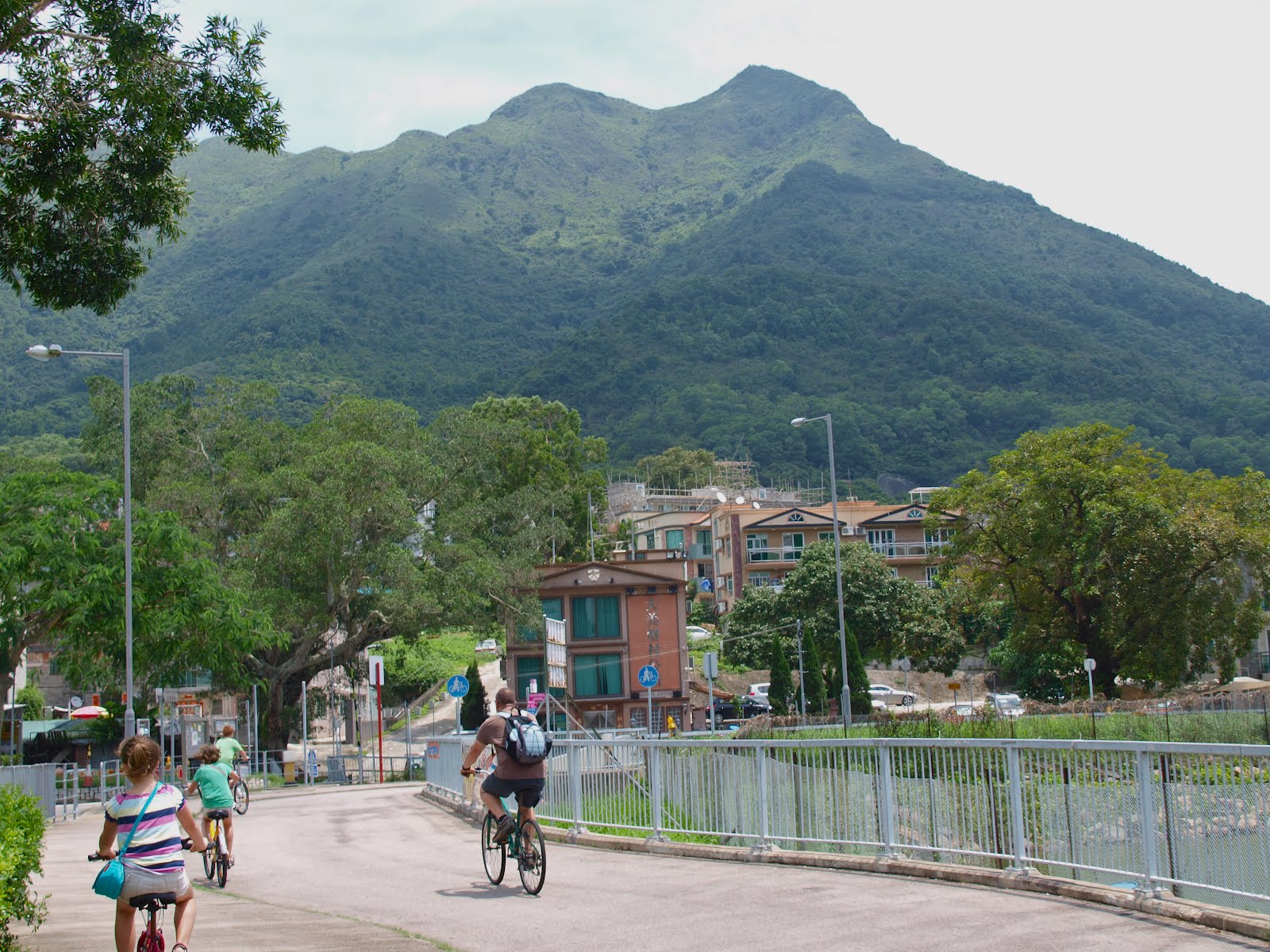
Woke up the kids to get an early start on our bike ride around the New Territories. We got to Tai Po Waterfront Park at 8:30 only to realize the bike rental place only opened at 10. Our sign language exchange with the security guard (with me pedalling in air and then pointing to my wrist to indicate the time) only highlighting the fact that we’ve been very lucky to have encountered as many English-speakers as we have to date. I know we won’t be so lucky in Beijing. We had an hour and a half to kill so we wandered up to the lookout where the breeze offered some relief from the already stifling heat. Scattered about the park were groups or individuals doing exercise of all descriptions — a traditional dance class for the ladies, a few Tai Chi practitioners solo or in pairs here and there, an older gent waving a sword around.

Most people had a little portable music device set up alongside them, pumping out tinny Chinese tunes. My favourite exercisers were a pair of women in their fifties standing on the end of a jetty facing the bay doing some seriously cheesy dance moves to traditional Chinese music. Age is definitely no obstacle to fitness here in Hong Kong and the early morning cool is definitely the time for the older set to socialize and get moving together. In what seems par for the course in Hong Kong, every single tree and plant in the park is meticulously identified. Happily, the Insect House opened at eight so we had a poke around, having a look at the local critters and the giant koi before settling into a history of China lesson for the kids. Wil did a pretty good job of synthesizing the country’s 5000+ year history in about twenty minutes.

While we waited for the bike rental place to open we encountered some kite flyers in the park. Most were men in their seventies, wielding what looked like retrofitted bike wheels to leash their kites. One man deposited his reel at our feet, chatting away to us in Cantonese, and walked several hundred metres away to position his giant koi on the lawn. Back at his reel he patiently waited for the gust of wind to get it airborne. Ubiquitous ladies in sunwashed coveralls, glow-in-the-dark vests and bamboo hats draped with all sorts of patterned fabric wandered around the park with wheeled carts, sweeping the leaves off the pathways with massive bamboo brooms. By ten, we were ready to ride.

The bike path snaked alongside the bay, initially shooting inland through an industrial park, past massive bakeries and waste treatment facilities, then along tree-lined streets near the shore. We shared the bike path with old men wearing broad woven, hats draped with dishclothes to protect them from the sun, packs of giggling university students, many of whom rode bikes with training wheels. The kids couldn’t get over adults with training wheels in the same way they couldn’t understand adults in Mexico who couldn’t swim. The highlight of the ride, for me, was hearing a man playing what I later found out was an erhu in the distance. As we approached, we caught sight of him in one of the shelters by the path, pulling his bow across this haunting instrument. Gorgeous, haunting sounds.

The sun was out for the first time. 30 degrees and 70% humidity but the breeze off the bay was constant and refreshing as long as we kept moving. We headed north along the shore toward Tai Mei Tuk, past villages squeezed between the road and the mountains jutting up to our left. Highrises line the coast in every direction. We took a couple of breaks, paying for the cold water bottles out of vending machines with the Octopus card. The girls visited with one shop owner’s Pomeranians and three caged cats. At another stop we watched tablesful of shirtless labourers hunch over their summer melon soup before digging in to their main course. Hong Kong is a prosperous town but more than half of its inhabitants live in subsidized housing — towering matte gray concrete structures dotted with colourful lines of drying clothes hanging from every window.

Most of my pit stops involved visits to the local toilets. This town is like a dream for the bladder-impaired. The variety at one’s disposal is fantastic. Most bathrooms have a selection of at least two types of toilet (as indicated with some interesting pictograms on the door), the Western standard sit-down and the Eastern standard squatter. This morning’s visits unearthed a third option — a mini toilet that only went up to Alice’s waist for pint-sized patrons. We opted to return the bikes at a different kiosk, making for a longer-than-expected 35 km ride. We stopped at the Science Park for a quick lunch, wolfing back some food before the kids ran off to play by the Park’s fountain, one that ran a close second to Bellagio’s. Back through more urban settings, we finished our ride along the Shing Mun River into Sha Tin where we dumped the bikes.
We got to see a couple being primped for photos minutes after tying the knot at the Marriage Registry and then hopped on the MTR back up to Tai Po. The network of bike paths in this town puts North American cities to shame.

Abby and James later took us out to the China Club for dinner. The building is unremarkable from the street, except that it is dwarfed by the giants around it. The height of any building seems a quick way to determine its age in this town. At a mere 15 floors, this former Bank of China Building is positively ancient. The elevator whisked us up to the thirteenth floor (unlike our Western superstitions, as a near homophone to the word for death the Chinese instead avoid the number four).

The 1930’s Shanghai décor makes it feel like a club right off the bat — lots of wood panelling, slightly cluttered with lots of lumpy upholstery, muted lighting and a extraordinary collection of artwork lining every available inch of wall. We started the evening on the rooftop overlooking the bay, lights on the façade of the new Bank of China building flashing beside us. The I.M. Pei building, long the tallest building in Hong Kong, replaced one of the oldest surviving buildings in Hong Kong, a colonial beauty that was taken apart brick by brick and relocated to Stanley on the south of the island. We continued in the diningroom with a fantastically delicious spread. If you’ve never been lucky enough to taste Peking Duck, I hope the China Club is your first experience of a dish that has been served in China since the 14th century. The waitstaff first emerges from the kitchen displaying a platter of perfectly roasted duck. Hanging as opposed to sitting in a pan as it cooks, much of the fat drips away and the skin is perfect and evenly crisped. Everyone oohs and aahs before they whisk it away. Then it’s back, in the form of a plate of thinly sliced meat with the skin on, alongside plates of sliced cucumber and spring onion, little bowls of hoisin sauce and a large plate of translucent pancakes. The idea is to fill the pancake with duck, veg and sauce and enjoy the combo of smoky, savoury, sweet and crunch. Round two is a bowl of duck broth that is too flavourful to describe. A new platter appears with fresh and oh-so-tender hand-shaped tofu curd (the look and texture of fresh mozzarella), seared baby bok choy and smaller but thicker slices of duck on the bone. All of it can be added to the broth, which really doesn’t need any addition to be perfect. The final round is a plate of perfectly round iceberg leaves and a heaping platter of minced duck to be mounded and rolled into the leaf and eaten. Another plate of mini bok choy appeared, this time pan-fried in garlic. Mmmmm. The Club’s creator, the Tang behind Shanghai Tang, cleverly offers up much of the dinnerware and table accessories at his nearby shop. Might have to go have a poke…

Can you say “consummate hosts?”

Tuesday, June 26, 2012

Hong Lok Yuen and Kowloon to Hong Kong Island

A quick drive to the Tai Wo metro station and down to Kowloon on the very clean, modern metro. The metro cars are articulated but there is no separation between cars so you can see from one end of the train to the other whenever it straightens out. It is surreal, like the endless reflection in face-to-face mirrors. When we emerged, the boardwalk was lined with schoolkids in uniform hamming it up for photos on their end of year trip and university graduates in robes, matching black pumps clutching their mortarboards to keep them from flying off into the bay. We hopped onto the Star Ferry that runs from Kowloon to Hong Kong Island, paying with the handy-dandy Octopus Card, the perfect combo between a debit card and a bus pass which works for everything in this town — bus, metro, the ferry, even buying treats in the local candy store. The view across the bay is spectacular — a line of green peaks the backdrop for an intense array of skyscrapers of every description. This land-strapped city, much of which is built on reclaimed land (or newly-made sand bars trucked in from elsewhere), is growing further and further into the water by the minute. Waterfront properties aren’t for long, as new skyscrapers pop up between them and the bay. Piles of steel i-beams, undoubtedly being readied to sink into the ground as ballast for the towering structures lie around in massive rusty piles. Downtown Hong Kong, known as Central, is unbelievably dense. What Montreal has in underground, Hong Kong has in aboveground. Covered walkways go off in every imagineable direction and they’re packed with a full range of people, hunched over old ladies with grandkids strapped to their backs with colourful fabric, tall Western men in suits and pointy shoes hustling to their next appointment. In one section of town endless escalators take you up block after block, all a floor or two above ground level, which has spawned a whole new slew of businesses benefiting from the newfound visibility. This city is all contrasts — skinny ladies decked out in the latest fashions teetering on their skyhigh pumps stride by little humpbacked grannies squatting by their food stalls, the narrowest alleys full of sweaty kitchen staff on their smoke break tucked in behind ridiculously high end retail stores, ultra-modern glass and concrete highrises ringed with rustic bamboo scaffolding. the narrrow bay and the tropical mountains have created a city, squeezing it into dense and dizzying heights. After a nice walk through Central, we got on the tram up to the Peak for more spectacular scenery. The tram line is implausibly steep. Even the views couldn’t keep thoughts of cable failure out of my head. We headed back down to find lunch. Aiming for the Cheung Wan Market, along with thousands of workers on their lunch hour, we settled for the food stalls on Stanley Street. The charming owner of stall number 5 convinced us that his homemade wonton soup was the ticket and we were happy to oblige. We perched on colourful plastic stools around a little white table in a long line of little white tables and wrestled the piping hot noodles into our mouths. The way home was a comedy of errors as Henri forgot his new toy in the pharmacy, we got on the wrong bus and ended up walking much further than we needed to in the now blazing sun. A half hour of navigating the maze that is Abby and James’s neighbourhood later we raced to get in the pool.

Monday, June 25, 2012

Hong Kong

After a short night’s sleep in an airport hotel we pulled ourselves out of bed at five to get the quick leg to Toronto. I was more than a little daunted by the flight to Hong Kong. The prospect of 16 hours trapped in an airplane seat was a bit scary but it was totally painless. Giving up on the idea of getting any kind of sleep helped. The more experienced flyers were snoring away well before the plane took off, getting their Hong Kong night’s sleep in early. I nodded off once but as soon as my chin hit my chest I woke up with a start and was wide awake for the rest of the flight — three feature length movies, four episodes of Downton Abbey, a few chapters of my book and a couple of cooking shows later. Hong Kong has got a new airport (which, thankfully, no longer involves flying a hairsbreadth from towering apartment blocks and looking into people’s windows). It is still impressive to drop down into the South China Sea, chock-a-block with sampans and container boats. There were no questions at immigration, just a quick smile and stamp. Big James was there, behind the crowds at the arrival gate, standing a good head taller than everyone else. We stepped outside into a wall of grey humidity, the jagged, lush mountains hanging like a curtain around us.
We crossed over some of the longest bridges I’ve ever seen, past a sea of lego-like containers and a long line of the cranes required to move them from land to sea. In the New Territories James took us through the maze of streets that make up his neighbourhood. The white, narrow streets are all concrete and stone, metal gates and walls with the trees and gardens all tucked in behind the houses. Once we were settled in we took a short walk up a long series of mossy stairs leading up into the green hills right behind the house. We climbed past a garden carved out of the hillside by the Hong Lok Yuen elders where they gather in the morning to drink tea and play mahjong. Gasping in the heavy humid air we made it up the first peak, where the paths weave their way along the crests, reminding me a lot of the hills around Los Angeles. The slick terracotta-coloured soil is the only place not exploding with lush greenery. The views changed as we went — Hong Kong Island, Tai Po, and nearby Shenzhen. We wound down the day with a delicious supper and a long swim.
Everybody slept all the way through the night which, apparently, is a big deal. Frances is nine today! Abby drove us down to nearby Tai Po to the Mega Mall to get our pictures taken for our visas for China. The air is heavy with rain. The mall is actually a series of malls. There is some question about the format of the photos for the visa but after the question is setttled, we take turns sitting at the back of the narrow store posing for the young woman holding the camera. The man at the front of the store’s english is perfect. The woman taking the photo, on the other hand, mimics us and points to bra straps to get us to adjust for the pictures. Our mutual sign language makes me all the more grateful to be with Abby; a dozen Cantonese words is not going to get us very far. After the photos, we wandered around and then Abby took us into the mall’s Dim Sum restaurant. The massive room was all mirrors, crystal chandeliers and hanging red tassles. The big, round tables are all packed with Chinese families. There are no carts in this place. Abby pores over the all-Cantonese menu and chooses without a word. We sip our tea and watch the ladies in red jackets wander from table to table with little steam baskets full of goodies. Through the huge plate-glass window we watch the rain come down in buckets. Soon enough, the ladies are bringing the baskets to us. Barbecue pork buns, steamed dumplings with shrimp and pork, deep-fried squid, barbecued pork belly, radish cakes, green beans in a mushroom black bean sauce, Chinese broccoli in nuts and the lightest, freshest noodles I’ve ever tasted. Each dish comes with its own yummy dipping sauce. Everything is ho ho sek (really delicious!). We don’t even come close to finishing it all. We’re all completely stuffed. After lunch the girls find an arcade
and all the students that are just getting out of school. Pairs of girls in chinese-collared uniforms hold hands and clusters of students in matching pants and white shirts stand in circles giggling or bunched around the air hockey table. We pick up a birthday cake for Frances and head back to Hong Lok Yuen.

Friday, March 04, 2011

the little van that couldn't

We return the rental and pick up the van. The price tag is spectacular but considering the transmission had to be sent all the way to Oregon, rebuilt and returned, I guess it wasn't so bad. We definitely have mixed feelings about picking up the van. The rental car was sooo easy. Being able to go 80 miles an hour, all the buttons and gadgetry, hell, just driving a vehicle that wasn't going to break down was such a huge relief. The very heavy undertone of worry and anxiety was suddenly gone. It made us remember just how carefree we were on last year's trip. Our Southwest leg put a whopping eight thousand kilometres on the odometer, not a moment of which was wasted listening intently for strange noises, desperately trying to ignore the sounds we did hear, or scrambling to find a mechanic to diagnose and repair the cause.

Back at Austin Veedub, the kids found their regular spots in the TV room. They have proven themselves the most undemanding travellers. They haven't once complained about being stuck in a garage. They don't complain when we forget to feed them because we're lost in the stress of a breakdown. They jump in the car with a smile on their face, unfazed at the prospect of a twelve-hour drive. This trip certainly has made me appreciate our little team.

We say goodbye to Austin as we drive up the 35 toward Waco. Of course, there is a mechanical hiccup. What's a drive without a mechanical hiccup? After about twenty minutes we pull off to fill up and, when Wil turns the key in the ignition to start it back up, nothing happens. And I mean nothing. Not a click, not a hum, not a whirr. Wil puts his head in his hands in disbelief. Here we go again. At this point we don't know whether to shriek or laugh or cry. We use our last coins to call Darryl at Austin Veedub and explain what's up — what Wil suspects is an electrical connection problem. A very nice Mexican guy in a pickup helps us push the van across the lot and then ends up towing us to bump start the car when he and Henri and Wil and I can't get up enough speed. We drive back to Austin VeeDub. Mike, the mechanic, takes about a minute to find the problem. Soon enough, we're back on the road and saying goodbye to Austin, again! I keep thinking the big white bubble from The Prisoner is going to appear in the rear view mirror. But this time we actually manage to get away.

We make our way northeast, through more flat scrub, across the state. We opt for non-interstate, as our new transmission seems to have us topping out at 95 instead of 105. We spend our time probing every town we pass through for non-chain restaurants. We're getting pretty good at finding them. We head for the steeple and look for what is often the only other surviving business on Main Street. Strip malls are well-named — stripping towns of their uniqueness, their heart (physical and symbolic) and replacing them with a sprawling line of Denny's and Arbee's and Applebee's. We were so happy to find the Downtown Café in Thorndale. The place had the feel of a poorly-lit, carpeted church basement, with an entire wall covered by the largest television screen I've ever seen. Our waitress was a sweetheart and she cleared up a mystery that had been puzzling us since we first entered the state. "What exactly IS chicken-fried steak?" She looked at us in amazement. "Y'all don't know what chicken-fried steak is??! You're not from Texas, are you?" Not a lot of tourists in Thorndale. She explained that it's a steak hammered down to a sliver of meat, battered and deep-fried like deep-fried chicken. The technique is also used for the "chicken-fried chicken." The boys couldn't resist. Their meals came out on very large oval plates and the battered meat covered 3/4 of it. All of it was topped with white gravy. Tasty but stodge city. A serving a quarter the size would have sufficed.

We kept working our way northeast and, out of nowhere a line of trees sprung up, followed by another and another, which meant that Louisiana wasn't far off. Trees, lovely trees. I hadn't realized how much I had been missing the trees. And so many were in flower, sprigs of delicate lavender and pale pink blooms like hands reaching out from the mass of sleeping oaks, explosions of white flowers atop slender trunks, even the occasional magnolia, its blossoms so beautiful they look painted on their skeletal frames. In the ditches, clusters of hyacinths and sunny daffodils squeeze up through the grass. It's good for the soul to see spring even if it's only a trick — a teaser of where we'll be in a couple of months's time.We spend the night in Marshall and start the next day crossing out of Texas.

We get through Louisiana in short order. These southern states, Louisiana, Mississippi and Alabama, are like fingers squeezed between Florida and Texas, as though they all got a miserly portion of the Gulf on condition that they take a long strip of swampland to the north. Leaving Louisiana, we all wonder at the mighty Mississippi. We drive through historic Vicksburg on the other side of the big, brown river and stop for lunch at Martin's in Midtown. We had a great soup and sandwich proving there IS good food to be had in this country, you just have to look hard for it. A group of older women, a grandmother and her friends are joined by the daughter and grandchildren at the next table. I am loving eavesdropping. The Mississippi accent is so strong, the kids and I find ourselves mimicking them unintentionally. When they ask for soup, the waitress jokes, pointing at our table, that "because of THEM there is none left for you!" They joke with us and eventually ask if we're the ones driving the van from Quebec. Yes, we say, all the while wishing we weren't. The grandmother, ignoring the job assigned her to chase the granddaughter around, talks to us fondly about Mexico as her daughter looks on in annoyance. As we're leaving, she says "Shore wuz nighs viztin with y'all."

Mississippi is flat. You'd be hard pressed to find a hill worth a toboggan in this state. No lack of swamp tho'. Giant blue herons wade in the flooded woods by the road, white herons swoop overhead, armadillos and possum lie squished in the ditch. I suspect the interstate system is single-handedly keeping the crow population fed.

Well into Alabama, we pull off the highway and suddenly there's a new sound. A grinding noise coming from the wheel that fell off in Chiapas. Uh oh. That familiar sinking feeling kicks in. We decide to ignore it and check it out in the morning. We do tours of the local garages and find the one that opens earliest. We watch the mechanics stride purposefully around the shop. They look suspiciously alike. The guy at the desk tells us they're twins. Identical twin mechanics working in the same garage... One of them gets the wheel off and tells us it was a little adjustment problem (the drum came off another van in Chiapas so this is not news). He pops it back into shape and off we go.

We decide that we just can't take the tension of waiting for another, inevitable failure. Dragging out the return home over several days would be torturous. We decide to just go for it, pull an all-nighter and get home a couple of days early, despite the fact that we have no house to go to or winter clothes to dress in. After supper, the beds go down and everyone tucks in. Wil and I take turns driving a tank a piece, keeping a close eye on the revs and the temperature so as not to stress it unduly. The van is driving like a dream. The brake pops out again but we decide to ignore it, braking as little as possible until we get home. Wil got us from Alabama to Tennessee and into Virginia, I kept on into West Virginia, Maryland and into Pennsylvania. After my shift, I managed to sleep through most of Pennsylvania and into New Jersey and woke up as Wil's turn was almost up. I pulled on some clothes and headed to the front of the van as he was pulling off the highway. His usually warm "welcome back to the front seat" never comes. He's hunched over the steering wheel, clutching it, white-knuckled. The van is moving slowly. Too slowly. He pulls over on the side of the exit ramp. Still half asleep I ask him what's up. Are we out of fuel? No, the motor just died. When he tries to turn it over he doesn't like how it sounds. As usual, I'm clueless and try not to badger him with questions as he struggles to put together mechanical clues that I don't understand. When he finally answers he says "It sounds like there's no compression (the kiss of death for a diesel engine). It sounds like we blew the head of the motor." I have a million more questions but the little I do know tells me we are not getting home in the van and I try to keep quiet as I watch Wil come to terms with this reality. Fuck this. This sucks.

Henri wakes up and, bless his heart, he tries to comfort us with words of encouragement and praise. The girls are mercifully sound asleep up top. Henri and I bundle up in the little winter clothes we have and head out to find someone to tow us as the sun is starting to come up. Wil waits in the van with the girls. A nice woman gives us a lift to a nearby (relative term when one is on foot) garage. The very kind but unhelpful attendant provides us with the Yellow Pages. When I comment on the cold in Spanish, he asks us about why I speak it. When I explain he tells us that he is Mexican. When we ask him where he's from he says, drumroll please... Puebla. It had to be. We race back through the bracing cold, trying to beat the tow truck to the van but when we get there the van isn't. We scan around and a guy in a pickup driving by tells me "Your husband is over there." pointing at the flashing lights. We run over and find that the New Jersey highway patrol has gotten to Wil first and pulled him up to a nearby hotel (where Henri and I were headed before the kind driver redirected us to the garage). After a little thought (not easy to manage after such little sleep) we realized just how pointless and undesirable was the notion of finding yet another VW diesel mechanic in yet another town we didn't know, followed by being trapped in said town. Morrisville seemed like a nice place but home is just too close.We got a room at the hotel, Wil kick started his brain and spent the next hour on the phone reaching out to friends to try to get us and the van home.

The kids stayed absolutely quiet for two hours as Wil and I slept, then we went out for some lunch and to pick up a rental car. We went back to the hotel for a little rest and waited for our knights in shining armour. Cedric and Rebecca turned up a few hours later in their truck with a flatbed trailer. When we thanked them they turned it around, in classic style, making us feel like there was little they'd rather do than go on a sixteen-hour road trip on a work day. Our SOS calls were answered with moral support from Phil, a fearless rescue squad in Cedric & Rebecca, a flatbed trailer from Roger, a place to stay (our house still being in someone else's hands) thanks to PK, and Dave, our welcoming committee, who is warming up the house and filling the fridge with groceries.

This trip has been more than intense, managing to combine some moments of pure joy with, without a doubt, the darkest moments of my whole life. Hand-wringing worry and debilitating anxiety have never really been a part of my existence but I certainly experienced them on this trip. And I hope I never have to again. I come away from this adventure so proud of our family and our ability to have a good time when things are falling apart around us. And despite our run of bad luck, how can I feel anything but lucky when we are blessed with such incredible friends.

Monday, February 28, 2011

west texas and beyond

The day began with breakfast in Rodeo, New Mexico, a few minutes across the state line from Arizona. Our desire to eat in restaurants that are not chains is a serious struggle in this part of the world. We get through several towns before we spot the Rodeo General Store with a small "cafe" sign propped on the window ledge. The store has all of three shelves and about five tables, a few of which are filled with locals sipping coffee and chewing the fat. The cook wears an apron "Born to golf, forced to cook". We are in the middle of the desert. We haven't seen a blade of grass since Los Angeles. Where would this guy golf? The menu is all eggs and meat. Everyone orders the McRodeo sandwiches (basically an egg mcmuffin) and I have a tasty, jalapeño omelette. We chat with the chef and the cashier about the cold snap that came through here a month or so ago. Several days of minus ten or colder in a place that rarely sees zero wreaked havoc on everyone's plumbing. Frozen pipes and no way to fix it once the plumbers ran out of supplies.

We continue along the I-80, which skirts the border for many miles. Mexico is the not-so-distant hills and it's torture to be so close. The road is completely deserted except for the roadrunner we see zip across it (meep meep). Flat, dead land stretches out for miles on either side with the occasional herd of cattle grazing (what they find to eat beats me). The only other vehicles we see are border patrol. I lose count after a dozen on a twenty mile stretch. On the crest of one hill, two trucks are parked side by side. One is fitted with a tower mounted with some sort of scanning device. The landscape is so bare, nary a bush and none of them higher than my knee. A man walking across this exposed expanse would be visible from miles away. Assuming someone could get past all this security, could they carry enough water to survive a trek through this parched desert? How desperate must one feel to think a possible future in America worth a deadly walk through the desert right into the gungho hands of the Border Patrol. It's just too depressing.

We go on, through Silver City, a place billed as one of the more authentic Western towns left in America. The man who first laid claim to the city (and the silver from which it got its name) lost it betting that he could outrun a horse. What is that saying about a fool and his money? This is the birthplace of Billy the Kid and the site of his first robbery. The house he grew up in was washed away, along with most of Main Street, in a flood a hundred years ago.

A quick call from a payphone to Darryl at Austin Veedub confirms that we just might make it home in the van. I'm so tired of being optimistic and then having my hopes dashed that I'm trying not to think about it at all.

We drive on. The Gila (pronounced Heela) Cliff Dwellings National Monument is forty-five miles up a dead-end road — the kind of road that would sour the most solid of stomachs. It is billed as a two-hour drive one way but we decide to tack the extra five hours on to the day because it is said to be worth it. By the road, Alice spots a mule deer. I see a baby partridge a few minutes later (The Partridge Family intro sadly the only reason I can identify the bird). A sign near the visitor centre tells us that this is also the birthplace of Geronimo, whose Apache name was Goyahkla, a man who lost all love for white man after his mother and wife and kids were butchered. His life story reads like a case study of just how poorly American/Native American relations were handled. But that is a tale for another day.

After a half mile walk along a gorge etched over millenia by the pretty stream running through it, we started up a narrow trail under beautiful sandstone cliffs. Near the top we were greeted by a volunteer park ranger who led us to the first in a series of caverns — a low, shallow one with a roof blackened by soot (the cookhouse). Built into natural caves on south-facing cliff walls, the Mogollon peoples erected walls of rock, mortar and timbers to keep out the wind and the cold. The spaces are divided into big and small rooms with windows and half-size doors, the roofs strengthened with timbers that have been dated to 1270. They didn't have the tools to cut down trees so they'd build a slow-burning fire around the base of a tree and burn for several days until the trunk was small and weakened enough to finish off with their stone implements. The process also protected the lumber from rot and pests. The walls don't go all the way up to the roof to leave enough room to allow the smoke to escape. Some of the rooms are tucked well back into the mountainside. It must have been pretty cozy in there with a nice fire and some animal skins to cuddle up under. Above the cliffs across the gorge (a steep climb down and up again without the aid of the park's handy dandy switchback trails) archeologists found evidence of vegetable plots. The Mogollon cultivated corn, beans and squash. One of the rooms still holds a cache of dessicated 700-year-old corn cobs which are half the size of today's. Ah, the wonders of genetic modification! There are also a few rust-coloured pictographs on the cavern walls. The most fascinating part for me was a two-story structure with tiny windows beside a huge, flat rock holding traces of uric acid and brain matter — the smokehouse and the tanning rock. The natural arch of the cave roofs frames a spectacular and different view with every step. What an amazing place.

By dusk, we're just outside El Paso. On the south side of the I-10, we pass miles of the feedlot equivalent for dairy cows, tens of thousands of cows standing in fenced pens of dusty mud. The smell is overpowering. The sight makes me want to swear off dairy. The I-10 turns toward the border and runs alongside it for a several miles. We see a sign that claims "Next 17 miles - Safety Corridor." What exactly is a safety corridor? The narrow Rio Grande is the only thing standing between the two nations. Well, that and a million border guards and all the high-tech gadgetry the US government can get their hands on. You could literally park on the shoulder of the interstate and throw a rock into Mexico. The buildings on the other side are of another caliber, low, colourful cinder block and no windows. Apparently El Paso and Juarez are now the most safe and the most dangerous cities, respectively, in the world. Juarez being such a hellhole makes it a little easier to swallow that we can't be on the other side. As the sun sets over Mexico, a sea of amber lights appear, stretching from horizon to horizon across the Rio Grande.

We stop to ask about a room but by some stroke of bad luck (I'm starting to take it personally) the girls' softball league, the boys' basketball league and some evangelical group have all decided to get together on the same bloody weekend. Dinner first. We head to Fabens, a little town outside El Paso. We're looking for the Cattleman's Steakhouse, meant to serve up the best steak in El Paso. We get off the interstate and, after a false start, find ourselves driving five miles along a deserted and very, very dark country road. I never thought we would find it but, sure enough, lights and a sign suddenly appear on the side of the road outside a tall wooden fence. We pull in and drive up the endless driveway through a compound that has all the trappings of a real ranch. The parking lot is packed with cars (and one saddled horse). Families are getting out of cars and heading toward the rambling one-story building. Where did all these people come from? We certainly didn't see them on the road.

The entrance is lined with glass cases, the first of which is a huge display of artillery (?), next are some framed photos of cattle and, further down the hall, the cattle in another incarnation, plates of cling-filmed raw steaks with little name tags. The place is all pine planks, chunky wooden tables and chairs and dining rooms full of Texans and Mexicans and everyone in between. We hear Texan drawls and Spanish but mostly English with a Mexican accent. The staff are all Mexican-American but, unlike most restaurants we've been to, we never hear them speak to each other in anything but English. After we place our order (I get the 10oz sirloin while Wil opts for the 1-1/2lb t-bone) Frances points at the long window behind me and tells me to have a look. I do and I see a display of antique carriages set amongst some bushes about halfway up the window, all of it illuminated by lights set into the grounds. Very nice, I think. And then something moves. A silver-coloured dog is chewing on something behind the carriage wheel, and then another dog just like it appears. And then I realize I am looking at wild coyotes through the window. Soon there are four or more of them and they are fighting over scraps on the ground, completely oblivious to the half-dozen people in the restaurant who are pointing and trying to capture them on film. They bolt away, only to return a few seconds later to sniff around.

James, our waiter, who seemed to slip Sir and Ma'am into every sentence, making me feel positively ancient. He brought us plates heavy with meat and mutant baked potatoes as big as the steaks. As promised, the meat was fantastic. The place definitely lives up to its reputation. If you're ever in El Paso...

On we go, through vast, boring west Texas. Again! Have I mentioned that Texas is huge? We decided to just drive and see how far we got... Through ranch country, places with curious names, like Ozona and Junction. How lame, I thought, not even a qualifier like "Mesa" to pep up the name, just plain ol' "Junction". Our attempt to avoid chain restaurants proves impossible so we opt not to eat at all. As we turn the atlas page from Texas (western) to Texas (Eastern) we realize that making it to Austin today isn't out of the question. We decide to just hammer out the miles. One little town we drive through has a general store with four saddled horses tied up to the handrail outside. What's ranch country without cowboys?

Pulling into Austin feels like coming home. Second only to Puebla. It's funny to think we've spent weeks getting to know two cities we only meant to breeze through. I'd say we got pretty lucky as to which two cities it was. We get ourselves a room and then headed over to South Congress, where we've had great luck with food. One of my favourite things about this town is the food trailer courts. If there is a better use for a vacant lot I can't think of one. A bunch of picnic tables clustered in the middle and, around the perimeter, a line of trailers, some barely big enough to hold a person never mind a kitchen, some elaborate (and beautiful) airstreams. The food is always interesting (sometimes only slightly more so than the artful descriptions on the boards leaning on the trailer). There's usually at least one taco stand, often some Thai, a sausage place, fries and burgers and at least one sweet (ice cream, chocolates or — all the rage in Austin — cupcakes). We walk and walk but don't find what I want. Wil and the kids finally get a artisanal hotdog to curb their hunger but I'm not willing to compromise. We walk some more. It feels great to use the legs after being trapped in the Town & Country all day. The heat, however humid, is a welcome change but my patience is starting to wear thin. We concede and buy some salad fixings, a little Chocolove and a bottle of wine to bring back to the room as the kids go to the candy store to fill up baggies of penny candy. As we're driving back to the hotel, we come across another trailer court with "A Little Thai" a few blocks away. I wolf back a Pad Thai, Wil sips up a Tom Yum as the kids happily chomp on spring rolls.

In the morning the kids all got a haircut at Bird's barbershop. I decide not to get involved in the child/hairdresser interaction and I am surprised by the results. The girls are thrilled. We pick up an air mattress at REI (MEC for Americans) to replace the one in the disappearing bag and take the kids bowling at Westgate lanes. Afterward we drive to Driftwood for the last thing on our Texas to-do-list. Barbecue.
The Salt Lick is in the middle of nowhere. A compound of low white gravel, sun bleached fencing around a parking lot that is chockablock. Lots of people heading for the restaurant are dragging coolers full of ice cold beer behind them. The place is BYOB. The story is that the man who started the place was sick of travelling around for work so he and his wife came up with a list of jobs he could do to stay put. There were 50-odd things on the list. Barbecue was number 14. He built a pit with his son and every Thursday went to start the fire and cook up some meat. He slept on a little cot beside the pit and only went home when everything was sold. He started selling out faster and faster. Soon enough, he was building a gazebo around the pit and the rest, as they say, is history. Now the place is massive. Our dining room, one of several, is wide enough for three picnic tables that seat ten twenty tables deep with lots of room to circulate. Outside, a guitarist picks out a tune for the al fresco diners. Everyone is enjoying the sunshine and 85 degree weather. We get ourselves some fresh-squeezed lemonade from a stand of Mexican girls at the door and order all-you-can-eat barbecue with all the fixins'. The waitress brings us a big plate of pork ribs, sausage cut on the diagonal and brisket, all dripping with yummy barbecue sauce. There isn't a dry piece of meat on the plate. With it comes a big bowl of potato salad, a big bowl of cole slaw, a plate of dill pickles and raw, sweet onion, more barbecue sauce and a habañero sauce. The plates of mammoth beef ribs being deposited on other tables look like something out of the Flintstones. Fingerlickin' doesn't do it justice. Without a doubt the best barbecue I have ever had.

We head back into town to Zilker Park, Austin's answer to Mount Royal, except that it's in Texas so it's huge and flat. The northern edge of the park runs alongside Lady Bird Lake, which is really a reservoir. Everyone with a kayak, canoe or scull is out on the water having a blast. Sadly, the park's public pool, fed by hot springs, is closed for the winter. We lounge around in the park watching people play soccer and beach volleyball. I don't understand why people feel compelled to wear bathing suits when they're playing a sport that has nothing to do with swimming in the middle of the city? Henri plays with his new balsa wood glider as the girls do Alice's favourite thing — what she calls "meeting people in public," which basically entails chatting up people with dogs. The smaller the dog, the thicker the girls lay it on. I am loving eavesdropping on my kids's conversations with strangers these days. It's always interesting to hear what they consider important to convey about who we are, what we're doing and how in the hell we got here.

We go back to our 'hood, to pick up a cupcake at the "hey cupcake" trailer for the kids. Noone is that hungry, after the massive meat fest that was lunch. I propose to Wil that we bring some food back to the room for dinner to save some money. Wil replies "We have no money to save."

We're both dreading tomorrow, the day of reckoning, when we have to pay for the rental car AND the car repairs. Tomorrow will probably set us back as much as the whole trip was intended to cost. Sigh.

Favourite t-shirts and billboards this week:
"Pick Jesus", "Runs with scissors", "oil is dumb", "Jean shorts are never okay" and
"Allergic to Church? God can help."

Saturday, February 26, 2011

sin city and bzzzzbee

We're in Vegas by mid-afternoon. I know it's one of those places on everyone's list, a place to see before you die. But I still don't get it. Despite my valiant attempts at being non-judgmental it feels like the white-trash capital of the world. The surrounding landscape is quite pretty — desert surrounded by jagged hills — but any natural beauty is washed out by the lights and the garish drama of The Strip. The hotels are gawdy as all heck. The one we chose, Bugsy Siegel's flagship, The Flamingo, is twice as expensive as any other place we've stayed but cheaper than many hotels on the strip. For some reason, I had a fifties kinda hep/hip image of Las Vegas before we arrived, something like Acapulco where the likes of Tony Bennett fit in. I guess I am fifty years too late. The sidewalks are full of lots of very loaded young adults carry around massive drinks in plastic Eiffel towers, dozens of people in hoodies flick glossy business cards with call girls's photos and phone numbers at Wil, until they see me behind or beside him. We had a drink on the sidewalk outside Caesar's Palace, two shots of tequila, a beer and one piñata for $45. We went up to the north end of the strip to Circus Circus to make the kids happy and walked through the labyrinth of the hotel — past a thousand machines, a few kino games, roulette, etc. before finding the "indoor amusement park". The casinos are obviously designed to make it as difficult as possible to find an exit. For a little over a hundred dollars we all got a bracelet and got to wander around the indoor amusement park with some very lame rides plus one decent roller coaster. I talked everyone into going on the roller coaster (a birthday present, I begged). Alice cried hysterically the whole time we were in line and then the whole time the roller coaster climbed. Scream, I told her. Scream and you won't be scared. The coaster did a couple of upside down loops and half the ride was in the dark. I screamed like a maniac and so did Alice. When we got off Wil was shaking, Frances was crying, Henri was being cool and Alice asked me if we could go on again! One down, two to go.

Afterward, we walked up and down the Strip looking for a decent dinner but didn't have much luck. The maze-like behemoth hotels lead you past every single betting device in the building before the restaurants. I'm sure there is good food to be found in this town but good, affordable food? I wanted L'Express but what I got was Battista's Italian Hole in the Wall. Menu written on the wall, salad served in plastic bowls, free carafe of wine with every dinner, ceilings covered with wicker baskets. You get the picture. We thought about a Cirque du Soleil show but couldn't swallow the $1000 price tag for two hours of entertainment. It almost made the Donny & Marie show at our hotel look good! I'm a little bit country... We did get to see the seriously impressive fountain show outside Bellagio. The carpeted casinos stink of smoke and are full of older men and women, many with walkers parked beside the slot machines, waiting for their ship to come in. They seem to be there morning, noon and night. When Wil went down to the lobby at 6 the next morning, he was chatted up by a couple of friendly "ladies" looking for a date. He came back to get us and, after watching the sun rise over the desert — an impressive sight from the twenty-second floor — we headed to the Bellagio buffet for breakfast. On the way, we passed two different poker rooms with at least three tables full of gamblers. Have they been up all night or did they start the session extra early this morning? Which is sadder? At least these gamblers are up against other humans instead of machines. Aack. I am beyond grossed out by this place. Breakfast was a bewildering selection of delicious treats. We all gorged ourselves and then got back to the car as fast as we could. We had a good time. Hell, we always have a good time but Las Vegas is, thankfully, no longer on my list.

We headed to the Hoover Dam, a reminder of how this quantity of humans cannot be sustained in this arid environment. The road zigzags down into the gorge toward the dam, past a security check (since 9/11, no doubt). We pulled over and walked across the structure, the drop into Lake Mead dizzying but nowhere near the height of the plummeting downriver side. Our house would fit in the overflow pipe alone. The dam, which apparently holds enough cement to pave a two-lane road from California to New York, is a monster and must have seemed all the more so without the massive new bridge that straddles the gorge.

The drive from the dam to Flagstaff, Arizona was beautiful. Sharp mountains, boulders crumbling everywhere. The rolling ground is pale brown dirt and brush, the patchy scrub looks like hair implants. As we get closer to Flagstaff, at 7000 feet, the temperature drops and snow starts appearing on the ground. Then lots of ice. I am sooo not ready for this! When I think of Arizona I certainly do not think of snow.

We pull into Flagstaff and drive around the cute little red brick downtown we'd seen passing through last time. It definitely feels like the West. We get a room at the Monte Vista, a hotel that's been in business forever. The check-in counter is all antique wood panelling and keys in pigeonholes. The elevator is so ancient you could probably run up the three floors before the elevator even got to the first. The low ceilings in the halls drip with chandeliers. We walk past the Siouxsie Sioux room and the Michael J. Fox room to ours, the Presidential Suite, which should have been called the Emperor's Suite with its crimson walls, gold ceiling and black trim.

Had a great night out. Drinks at Cuvée 928 and dinner at Pasto, a cute, modern Italian place. We passed on an amazing-looking Barbecue Pit and a few other restaurants that more than appealed. We could spend a few days here just for the food. In the morning we had breakfast at the Grand Canyon café, where the menu is split down the middle into Chinese and American dishes. We sat at the bar and our sweet but flaky waitress flapped around getting our orders wrong. We got on the 17 headed south, stopping at Arcosanti, a ecological community designed by Italian architect Paolo Soleri, a former student of Frank Lloyd Wright's. Made of packed earth and a serious amount of cement, the string of structures were created as a model for a self-contained community of five thousand people. The exterior is a seventies take on modernism, lots of domes and circles and cubes, all of it held together with a truckload of Flextra. The interior is filled with light, some early Ikeaish furniture, a lot of stained glass and a thousand chimes. All that was missing was some macrame. I was sorry to miss the one-hour tour but we took a walk into the hill opposite to get a bird's eye view. We asked some questions when we got back. Only fifty people live in the community now, apart from the students who rotate in and out every five weeks. We kept on heading south, running from the big storm that was set to hit the north of Arizona. We may have run too fast. We managed to lose another bag. Big L. We're starting to think that the unfortunate luck we've had on this trip is balancing out the rest of our happy life.

Through Phoenix, a town even the guidebooks claim is better avoided. We have lunch on the road. After we eat we see a sign on the door that tells us the water contains high levels of nitrates and should not be given to infants under the age of 6 months. Yum. As Wil stands in line for lunch, he notices that two of the men are carrying handguns. Just regular looking guys. What's up with that? We stop at Walmart in Benson, to find some more DVDs now that the kids have made it through the Harry Potter series. As always, the place is depressing. A woman sat, wringing her hands, across a small desk from what looked like an accountant. I'd assumed she was filing her tax returns but the sign on the cardboard booth said "Refund anticipation loans."

Through Tucson, past an endless string of rv camps, places with no shade, no privacy and no charm, past a benedictine monastery (what the ???), tantalizingly close to the mexican border and on to Bisbee, a small town with a big reputation. We went all the way through town to look around. On the south side is a series of vast fenced-in terraced pits with a nasty-looking pond at the bottom; the reason the town is here, the copper mine. Once upon a time, Bisbee was the biggest town between New Orleans and San Francisco. The downtown is regal, red brick buildings, lots of old mining equipment, streets that look like they were pulled out of a Western. Set into a steep hillside, many of the streets have staircases, many doorways and front lawns are creatively decorated with bottlecaps and other found objects. There is definitely a big artistic community here. We go for a walk around town. It feels comfortingly a bit like Mexico. We book into the Copper Queen Hotel, a grande old dame of a place, which is haunted by three (count'em, three) ghosts. We were lucky to get a room, as every thursday night the fourth floor is blocked off for the ghost hunt. For $287, a couple gets a room, coffee & desert and an evening of ghost hunting — complete with EMF equipment and ghost stories.

We head out for dinner to Café Roka. A warm, inviting little resto tucked in among the quaint shop fronts of Main street. Our maitre(sse) d' is either half-baked or working hard on her Mae West impersonation. The waiter is a malcontent but the meal is absolutely sensational. Finally some vegetables!!! A four-course meal with soup, salad, sorbet and a fantastic entrée. Wil and I shared some great olives and a super-savoury hummus, then Wil dug into a steak and I had a lasagne layered with eggplant and artichoke and three sauces, béchamel, spinach and tomato. Key lime pie and crème brulée to die for. We ask the busgirl what the population of Bisbee was. By way of an answer, she tols us her senior class has seventy kids. She also tells us that the mine recently opened again, for the first time in her life. I suppose skyrocketing copper prices have made the cost of its extraction seem a little less prohibitive.

In the morning, we're heading for Texas. It seems the repairs are going well and we just might make it home in the van after all.

Thursday, February 24, 2011

Lalaland

On our way to LA, we find Peggy Sue's Diner in Barstow (and so do a hundred other people — people on their way to and from Las Vegas). The fifties-style diner's menu features all the classic diner plates you'd expect, plus a couple of new ones. We couldn't resist one in particular — wedges of dill pickle dipped in batter and deep fried, served with ranch dressing. I blistered my palate but it was so worth it.

When we finally hit LA and shifted from the "Southern California" page of my atlas to the "Greater Los Angeles" page, the scale took me totally by surprise. I can't quite believe how massive the city is — we drove the distance from Montreal to St. Sauveur and were still nowhere near the other side of town. I'd expected LA to be full of flat, wide, treeless streets and detached bungalows. Instead, the parts of the city we were hanging out in were as green as could be, settled into folds of canyons. Seeing the addresses painted on the curb brought back flashbacks of a dozen childhood shows. We drove into Glendale where Steve and Kim live with their two girls. Glendale is a pretty neighbourhood of tidy little forties bungalows interspersed with designer modern homes. The roads are so winding and steep that every window frames a pretty view of rooftops or greenery. Steve and Kim's house is something out of Leave it to Beaver, white picket fences in a perfect green lawn under a round-leafed shade tree with a white tree swing, all of it framed by the window over the kitchen sink. What is it about watching your kids on a tree swing with your hands in a sink full of dirty dishes that makes you feel like a real MOM. Where's my apron?! The interior of the house is wallpaper from the sixties, gingham curtains, blue and white porcelain spice rack. The back yard has a pretty little patio and steps up to the secret garden and the trampoline. It's the first time since Chiapas that we've seen trees in leaf. The garden is lush, roses blooming all around us. It is so nice to not drive for a while, to hang out with some good, old friends and just shoot the shit. Our girls and their girls pull out the Barbies and Polly Pockets and pick up where they left off this summer. Henri dives into his new Beatles' book and tries to stay out of their way. The weather is crap, cold and rainy but the attraction to LA is IN the house as far as we're concerned so we're happy as clams.

When the weather breaks the next day we go for a walk. Minutes away from the house is a trail that hugs the green ridge of the San Rafael Hills. The trail switches back through waist-high bushes, each step releasing a cloud of wonderful scent as we brush up against the sage and other fragrant herbs pushing their way onto the trail. Plants that horticulturally-gifted friends spend their summers struggling to grow in their gardens pop up like weeds in the middle of the trampled paths. The view is spectacular. Kim points out the surrounding neighbourhoods and the nearby mountains of Angeles National Park which were ablaze in the last round of LA forest fires. The wind is fierce. It's easy to see how a forest fire could ravage this area in no time flat. The green hills all around us are woven with trails that lead from canyon to canyon.

The next day, Kim, our most excellent cruise director, took us on the tourist run of LA, past the Hollywood sign, through Hollywood and Beverley Hills — a long line of stars stretch out for miles on the sidewalks. I realize as we drive around that most of the names of people and places mean very little to me. We're on our way to the Getty Centre to meet Wil's brother, David, who's been living in and around LA for years. We park the car and take the little monorail up to the hilltop site. The free museum is spectacular — cubes of pale stone piled high like lego blocks around huge panes of glass. The desertlike gardens meander around and between the buildings leading past sculptures of steel and bronze and stone. A glimmering chute of water bubbles down the hillside and collects in an elaborate maze of crimson flowers. The kids are frustrated because they're not allowed in any of the green spaces. We lead them through a photo exhibit of early and contemporary Chinese photos but they soon run out of patience and end up in the Family Room where they can wrestle and jump. They all emerge with hand-drawn masks. Sitting in the sunny courtyard as we wait, the people-watching is excellent. The variety of the Getty Centre clientèle comes as a relief after the colourless southwest — women in full, black hijabs, Japanese tourists, yarmulkes, turbans...

On David's suggestion we head down to Patrick's Roadhouse, a restaurant on the beach at the end of Sunset Boulevard. After our yummy lunch we go through a flooded tunnel under the Pacific Coast Highway to the beach, the Pacific glistens in the afternoon sun, Catalina Island's a hazy bump on the horizon. Kites are flying, a blimp roams around above us. Hundreds of seagulls scour the beach for snacks. When they take to the sky, it's like a white cloud. The kids play in the sand as we sit around and chat. David tries to impart some of his vast knowledge of the Southwest. After an hour or so of kicking around on the beach, we say goodbye to David and our friends and hit the PCH up to Topanga.

The freeways here remind us of how differently Mexicans and Americans use vehicles. Mexicans use a trip to pack in the most people and goods, while Americans invariably have four empty seats in the car. The fact that a car only needs to hold two people to qualify for the almost-always-empty carpool lane says it all. The absence of decent public transport in a sprawl like Los Angeles is shocking. If this were Mexico, every thoroughfare would have a constant flow of colectivos scouring the sidewalks for passengers.

We turn off the PCH toward Topanga, a winding road through a lush canyon where jagged golden sandstone and greenery hang high above you. The cliffs are covered in gnarled, mediterranean plants that have found a foothold in the shallow, rocky soil. The town itself feels a lot like a very low-key ski resort town, hippies and groovy little shops scattered in the narrow patches of flat stretched out along the road. Pretty soon we were pulling off the main road and creeping up one of the steep trails leading off the boulevard. The house is a wonder. In total contrast to the tidy traditionalism of Steve & Kim's, it is all glass and concrete and views. What the two houses do have in common is the warmth — of the home and the hosts. Half an hour later we were all in the hot tub, gazing out at the sandstone and the curtains of green hill that hide the Pacific from view. Definitely a little piece of heaven. The kids fished frogs out of the pool as we got dinner together. The girls followed their new hero, Kali, around asking a million questions about makeup and heels. Beautiful Kali was as gracious and lovely as ever.

The next morning we hung out, did some homework and then drove back into LA. We parked near the Santa Monica pier and walked along Venice Beach. I find visiting a place so often featured in TV and movies tends to make everyone there look like they've been cast in their roles. All the characters you'd expect — lots of tattooed skin, homeless guys strumming guitars, vets in wheelchairs, teenagers in short shorts and cowboy boots, families cruising around on rented bikes, students on long skateboards, bikini beach volleyball, surfing lessons in wetsuits, facelifts sunbathing in chaise longues by cafés, career drunks in baseball caps soaking up the sun in the streetside bars.

We head off the strip through quiet, little green alleys to find Mona Moore, Lisa's store, a white, understated space that displays the wares to full advantage. The girls gape at the impossibly high heels while I admire the grey flats. All the footwear is a work of art. After our visit we head back to the strip for lunch on a sunny terrasse.

Later we head back to Scoop's house to hang out. It's hard to imagine that their quiet, rural-feeling home is a mere fifteen minutes from Venice Beach. Kali gives the girls a makeover and lets them try on endless pairs of heels as Scoop, Wil, Henri & I head out for a walk on the trails around the house. Being able to rise above the crowds to escape the congestion for a quick walk in the trees sure alleviates any feeling one might have of being trapped in a metropolis. Henri hunts for sandstone caves as Shuggie, the chocolate lab, zigzags across the trail tracking down rabbits. As we take in the spectacular views, Scoop talks about the forest fires that regularly tear through these canyons and the earthquakes that threaten to shake coastal cities into the Pacific. The perils of living in paradise. When Lisa gets back from work, we enjoy a delicious lamb dinner, some yummy red wine and pore over some great family photos.

We say goodbye to our excellent hosts in the morning and head inland into the San Fernando valley (like, gag me with a spoon!) quickly getting stuck in one of five lanes of traffic inching its way toward downtown. We manage to find an alternate route, the poetically named Pearblossom Highway, and were into the country in no time. Joshua trees sit tiny beneath the gigantic towers holding the power lines off the desert floor. We also see the Los Angeles Aqueduct — a wide band of shimmering water meandering through the desert toward the city. The snow-covered north face of the San Gabriel Mountains now sits between us and Los Angeles.
A quick stop at In N Out Burger in Barstow. It's hard to go wrong with only four things on the menu (three kinds of burger and fries). In the desert, the ten commandments appear in white billboards on the side of the highway.

Saturday, February 19, 2011

Nature's wonders in the Southwest

We got a room at the Historical Taos Inn, in part because we could feed the kids, pop them in front of a movie and have dinner à deux at the hotel's restaurant. We all had drinks in the lobby and chatted with the manager of the place, comparing notes on travelling in VW vans. The beauty of being in this mega-tourist zone in the winter is the unhurried treatment we get everywhere. When we told him about our romantic dinner plans he got the waitress to bring some chicken tenders to the kids and then surprised us by not charging us.

It was lovely to have a little time alone (possibly our first ever Valentine's dinner out) but the meal was manqué. Good concepts but all of it too heavy, or too light or too bland. Our fellow diners were all of the new-age granola variety and the background music was provided by open-mic night in the adjoining bar — a man playing the melodica (poorly) to a recording as his girlfriend did an interpretive dance. I spent the rest of Valentine's discovering the difference between a laxative and a stool softener. Hell, who needs ten days for a cleanse when you can do it in five hours?!

Wil took the kids out for a walk in the morning. Not a soul on the sidewalk, everyone in their car. I'm starting to realize (HELLO!!) that outside major city centres, this country is all about cars. If you're not shopping there doesn't seem to be much point in walking anywhere. Time for a little nature break.

Just outside Taos we came upon the wildest community out in the middle of nowhere. The Earthship Landing Zone is a collection of dwellings dug into the desert floor that look like they were designed by someone on some major hallucinogenics. Wild, organic shapes, colours not usually deemed appropriate for houses, walls of windows facing the sun, all built of stacks of old car tires and completely off the grid — using minimal resources and using them well. I had a poke around the web and the interiors are pretty cool too. 

We headed up into Colorado, through some lovely pine forests, past ranches (one called Bad Dream Ranch with an effigy of some guy in a noose hanging from the high gate — welcoming touch!), horse farms and a lot of snow. The Rocky Mountains kept us company almost the whole way. We were heading to Mesa Verde National Park to see some Ancestral Puebloan cliff dwellings. I thought that, prior to heading into some of the reservations, it would be worth seeing something of the peoples who inhabited this land before the whities came along. As we got close, I read that the park is only open from March to November. Crap.

We crossed over into Utah and started heading north, stopping in at the Hole N" the Rock fifteen minutes before it closed. The tour, which according to our well-rehearsed guide, is meant to last twelve minutes was (unintentionally) hysterical. We stepped through the doors of the gift shop and into the side of a sandstone mountain. Our guide whisked us along, through the creation of Albert Christensen & his wife, Gladys. The couple first opened the attraction as a diner when the local uranium-mining business was going like gangbusters. Albert liked it so much he went on to blast a five-room home out of the mountainside. A sandstone cave with three large columns and a couple of walls with windows on the exterior, the place is far and above the finest example of kitsch I have ever seen. According to our guide, Albert was a chef, sculptor, painter, carpenter, barber and taxidermist (I'm sure I'm forgetting a few). Whether he performed any of these activities well is another matter. His awful (and nearly identical) paintings of Jesus hung on many of the "walls", along with a half-completed bust of Benjamin Franklin. The furniture was all fifties and sixties, the kitchen and bathroom fittings all pale greens and blues with big concave silver knobs, the upholstery nubbly browns and tans. The missus had a penchant for tchatchkas and apparently liked to chip away little alcoves in the stone walls to display her hundreds of figurines. Also in the house are two stuffed horses and a stuffed mule, his first attempt at taxidermy and not a very successful one. The beloved mule, who helped Albert haul all the busted rock out of the hole, looked like he'd been attacked with a bat after a wax job gone wrong. Tacky doesn't even begin to cover it. I was sorry to not have more time to really pore over the place (and even more sorry not to be allowed to take photos) but we were definitely getting the "get the hell out, it's closing time" vibe. What a place. What a surreal job.

We got ourselves a hotel room in Moab and let the kids party in the pool and hot tub and, in the morning, drove the few miles up to Arches National Monument. The park is, without a doubt, one of nature's masterpieces. The nine-mile loop road leads you past what look like a giant's plasticine creations. According to another friendly park ranger, the formations were the result of an inland sea depositing a thick layer of sand over an unstable salt bed that eventually gave way, creating cracks and collapses. Whatever caused them, they are beautiful beyond words. Petrified sand the colour of clay in awe-inspiring waves and cracks, towers and arches. We went for a hike up to Delicate Arch, the image that appears on the Utah license plate alongside the logo "Life Elevated". We raced up the steep red track to get the lead on a bunch of fourth graders being herded along by teachers and park rangers. All around us were incredible rock walls and canyons, peppered with eroded nooks and crannies. The worn traces of millions of years of spring streams and rainfalls in this arid environment evident in perfectly round dents in the rock. Aside from a trio of very discreet Japanese tourists we had the Arch to ourselves. The majesty of the place had us all gob-smacked. The kids and I ran around as Wil acted brave and wrung his hands at the proximity of his loved ones to perilous drops. The kids spent the walk down tucking themselves into little cups in the mountainside. Wow.

We drove on, toward Natural Bridges National Monument and had a quick look at more arches. The first one, Sipapu, was named for the place where the Hopi emerged from the underworld. We also saw Horse Collar Ruin. We stood on the edge of a cliff and looked down on the remains of a thousand-year-old dwelling tucked into an alcove near the canyon floor. The weather was starting to turn and we didn't have the courage to tackle a long hike so we settled for some short walks to the lookouts to see the other two bridges. 

Down highway 261 toward Arizona, with a quick detour to a place called Muley Point, where the road drops off an area of rolling fields dense with cedar and juniper called Cedar Mesa, into the Valley of the Gods. The red dirt road is about five miles off the highway, past grazing cattle and grates, to the end of a finger of rock that points the way to Monument Valley. The wind practically knocked me over as I tried to capture, in vain I fear, the spectacular view on film. Standing on a precipice, straddling foot-wide cracks in the rock, the stone towers of Monument Valley like sentinels, casting massive shadows on the horizon, the San Juan River snaking through the canyon striped like a full-colour topography map below. Again, we found ourselves shaking our heads wondering if we were still on planet Earth.

Into Navajo land on a hairy, one-lane switchback gravel road that drops down into the valley. We were pretty happy not to have to back up to make way for a car or truck on its way up. We were too late to make it into Monument Vally Park (damn winter hours) so we headed down the road to Kayenta, the next town. We checked in to a hotel, a lowslung affair where native flute music is constantly playing in all the public spaces of the building. The effect is cool for about as long as it takes to check in, then it starts feeling like you're in the waiting room to see a masseuse. The place was staffed entirely by Navajo, underscoring the fact that we might well be in the US but we were, first and foremost, in the Navajo Nation. The hotel restaurant was meant to be the best in town and we were served by beautiful raven-haired waitresses in black — colourful belts cinching the waist of their long skirts (the look only slightly marred by the jeans visible under the hem). The other guests are an extended family of Chinese tourists, mining men — a reminder that the uranium market is rebounding —  and an older Mennonite couple, complete with Abe Lincoln beard and doily-like head covering. Wil and Henri had a Navajo Taco, a plate full of Indian fry bread, a ten-inch across, half-inch thick disk of fried dough covered in pinto beans, chopped brisket, cheese, tomato and lettuce with a side of salsa & sour cream. A nice, light meal. The hotel was pretty enough but we got a bit creeped out by the place. It felt haunted and, I suppose, in a way, it was. We drove up the road to the Park first thing in the morning. Barebones houses, few and far between, scattered in the desert, roofs covered in old tires to keep the tin and asphalt shingles safe from the wind, rusty pick ups parked outside, barbed wire fencing driven into the red soil, upwind side piled high with tumbleweeds. Aside from the monuments and the infrastructure to handle the tourist onslaught, the land is practically empty. It makes one wonder why white men were so desperate to tear the Hopi, Apache and Navajo from this land. There is no doubt that this is a deeply spiritual area. If you want to commune with nature, you've definitely come to the right place but I found it hard to not let the undercurrent of massacre and displacement taint the sheer majesty. 


After Arches, Natural Bridges and especially the view from Muley Point, Monument Valley was actually a bit anti-climactic. We got there just as the sun was rising, the beautiful rocks towered above the desert floor, the east faces lit up in orange and pink. Again, we were almost alone in the place. I think the monuments are perhaps better seen as a group, from a distance, when they look like giants looming in the red desert. The Visitor Centre had a fascinating display on the Navajo Code Talkers, Navajo men recruited to serve in World Wars I and II to use their native tongue to transmit secret messages that noone could decode. Later we saw billboards celebrating the names of the first 27 Code Talkers.

We went on to the Grand Canyon, a three-hour drive south west. Why did I always think it was in Colorado? We entered the park from the east and got our first glimpse of the canyon from the Desert View watchtower. To be honest, it wasn't all that different from what we'd seen earlier in the week but the scale! It was just too much to take in. We drove further along the rim and parked the car off the road in a spot we'd read about. According to our guidebook, we should ignore the "Only by Permit" sign and jump the chained gate for a more private viewing of the canyon. We had a quick lunch out of the side of the van and meandered up a dirt road into a gorgeous pine forest.  The mile-long road was so muddy in places we had to weave our way through the woods where we spotted some impressive tracks and some wolf scat. At the end of the road was a lovely little clearing dotted with rustic picnic tables and a latrine. We followed the path toward the edge and found a little track that led out onto a narrow spit that jutted out into the canyon. As the sides dropped away and the spit narrowed further, Wil begged off. The kids and I held hands and walked single file as far out as we dared. I have no fear of heights but a mile down is a hell of a long way. We sat down near the end, on a natural shelf of rocks and had a good look around. Absolute quiet, not a human
or manmade structure visible as far as the eye can see, which is saying something in this setting. The canyon walls opposite are layers of rock laid out in colourful stripes. From this height, the river is just a tiny string on the canyon floor. It's hard to imagine that that little (from here) river is the cause of this wonder but I suppose if you do anything for 1800 million years... After the kids were back on solid ground, Wil decided to have his own look at the view. How lucky we felt to have this magical spot to ourselves.


Back at the car we drove into Grand Canyon Village to see whether we wanted to spend the night or get some mileage done to cut down on tomorrow's drive. As we tidied up the back of the van we noticed that our red backpack, the backpack that held Wil's laptop and every stupid cable to charge computers and cameras and ipods, was no longer with us. We racked our brains and my heart sank as I vaguely recalled putting the backpack on the ground in a parking lot somewhere. A couple of desperate phone calls later the bag was located... in Monument Valley!! Aargh. As Nicky, Wil's sister, put it, karma is not on our side on this trip. Although some good samaritan was kind enough to turn the bag in, which is luck enough. My gaffe tacked an extra six hours on to our drive. To add insult to injury, we had only one option as to how to get there, forcing us to do the same, extremely boring stretches of road three times in the same day. It was a bitter pill made much easier to swallow by Wil, who didn't even bat an eye or do the easy thing and make me feel like even more of an idiot. As we drove back I read to Wil about the bloody and fascinating histories of the Apache, Hopi and Navajo to pass the time.The one consolation was watching the full moon emerge from the desert floor behind the monuments when we finally made it back. By nine we were in Flagstaff, ready to crash.